


Artificial Intelligence (AI) is no longer a futuristic technology; it’s here and now. According to McKinsey's State of AI report, 78% of organizations now use AI in at least one business function — up from just 55% a year earlier. People often view AI’s contribution to businesses mainly through chatbots and virtual assistants that interact with users, but there’s much more happening behind the scenes. From automating repetitive tasks to enhancing products and services, AI-powered business solutions are transforming business operations across industries. The core purpose of AI in business operations is to improve operational efficiency by automating predictable and straightforward tasks while allowing humans to focus on strategic decision-making. Human discretion and guidance remain irreplaceable. In fact, many successful platforms rely on human-in-the-loop AI systems to balance automation with oversight. This collaboration between humans and machines enables organizations to improve customer satisfaction, strengthen data-driven decision making, and drive innovation and growth. In this blog, we explore real-world AI use cases in business to understand how enterprises are adopting AI applications in business operations to run more efficiently.
How Artificial Intelligence is Transforming Business Operations: Insights from Research
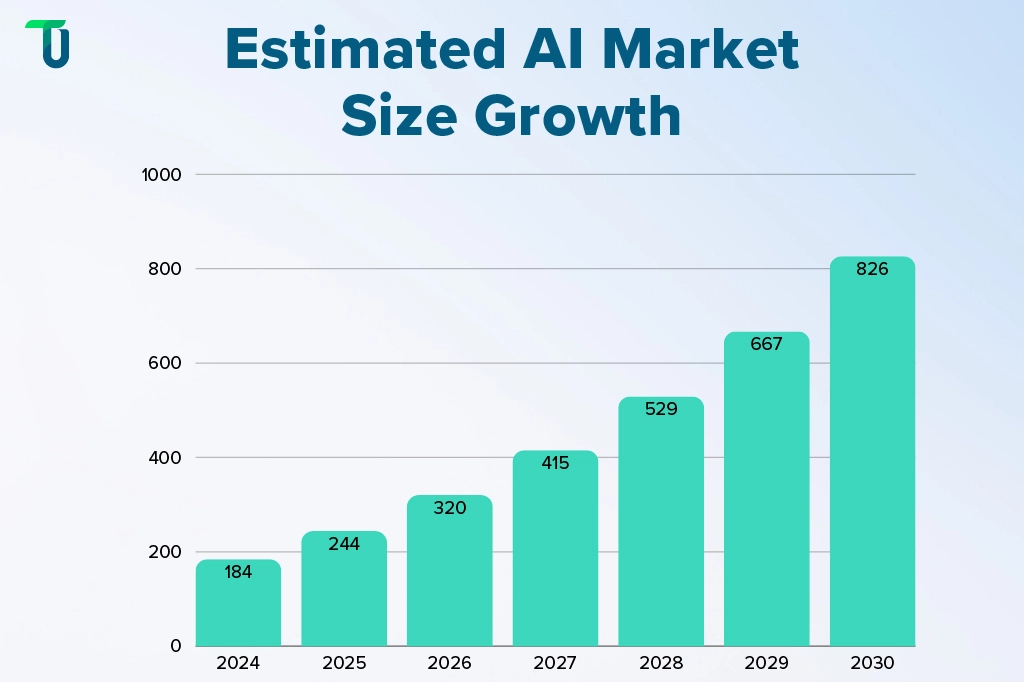
Did you know that the global artificial intelligence market reached USD 184 billion in 2024? This growth is driven by the increasing adoption of digital technologies and a stronger understanding of AI's capabilities in automation and business process optimization. Key market highlights include:
- The market is expected to reach USD 826.70 billion by 2030, growing at a rate of 28.45% during this period, according to Statista research.
- This rapid expansion highlights the rising importance of artificial intelligence in business operations worldwide.
Another research report by Markets and Markets suggests that the software segment is a major contributor to global AI market growth, driven by two core AI capabilities:
- Discriminative AI — focused on predictions and classifications
- Generative AI — focused on content generation and other NLP-based tasks
These capabilities are powering real-world AI use cases in business across industries. Core business functions increasingly adopting AI-powered business solutions to improve efficiency and decision-making include:
- Marketing & Sales
- Human Resources
- Finance & Accounting
- Operations
- Cybersecurity
Early adopters are already seeing benefits such as improved productivity, operational efficiency, and cost savings. Innovative products and personalized services enabled by AI applications in business are reshaping consumer expectations for speed and convenience, fundamentally changing how organizations operate to remain competitive.
Need Help with AI Adoption for Your Business Operations?
We will analyze your business needs and recommend areas where AI integration will provide tangible benefits.
Real-World AI Applications: Transforming Business Operations with Use Cases
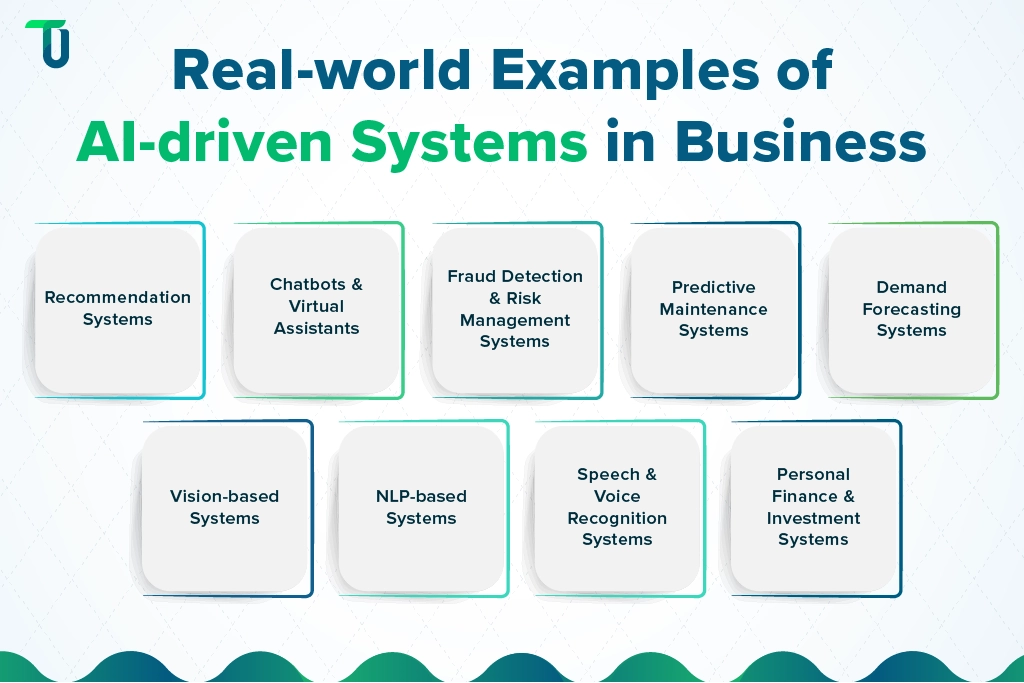
Let’s explore the most commonly used AI-driven systems and how they are utilized by different business functions across industries:
AI-driven Recommendation Systems: These systems combine data with machine learning techniques and sometimes predictive analytics to provide personalized recommendations. You must have noticed how YouTube suggests videos similar to the ones you usually prefer and Amazon recommends products similar to the ones you searched for earlier, that’s a recommendation system in action.
Understanding what machine learning's role in business intelligence starts here — ML algorithms continuously learn from user behavior to deliver smarter, more accurate outputs over time. Use cases include:
- Analyzing consumer behavior and recommending products to improve discovery for customers, and encourage additional sales for E-commerce platforms.
- These AI platforms for personalized e-commerce recommendations also deliver measurable benefits of AI in personalized product recommendations such as higher average order value and improved customer retention.
- Creating a tailored viewing experience by providing personalized content recommendations by analyzing user preferences and viewing patterns for media and entertainment platforms.
- Allowing dynamic pricing models in the travel and hotel industry by analyzing demand, seasonality, competition, etc., and enhancing pricing strategies for increased profitability.
- Offering personalized learning paths, improving student engagement, and encouraging course completion tailored to students’ interests and skills.
- Creating targeted marketing campaigns to increase conversion rates by analyzing consumer data and audience segmentation using predictive analytics.
- Enhancing IT operations (AIOps) via automation, optimization, and recommending the course of action to IT professionals.
AI-based Chatbots and Virtual Assistants : Commonly utilized to enhance customer experience, they provide business benefits like scalability, consistency, 24/7 availability, and more. Understanding how AI improves customer experience platforms becomes clear when you see these systems in action — they reduce response times, personalize interactions, and free human agents for higher-value tasks.
Virtual Assistants used in the Banking and Finance sector are highly popular. For example, Bank of America's Erica provides guidance to customers and automates common queries.
- Generating leads by engaging customers, learning about their needs, and collecting contact information.
- Monitoring social media and providing personalized responses to customers' comments or queries.
- Assisting event managers by automating responses to queries concerning ticket prices, schedules, locations, etc.
- Collecting patient data, scheduling appointments, and even giving preliminary advice in healthcare institutions, as demonstrated in our IoT device integration in healthcare case study.
- Providing real-time assistance to customer support employees and freeing them from repetitive work to handle more complex tasks.
- Reducing cart abandonment rates, tracking orders, and helping customers find products on e-commerce sites.
AI-powered Fraud Detection and Risk Management Systems : As all industries face fraud and risks in some form, these systems find many applications. Businesses looking to compare AI solutions for fraud detection will find that modern platforms range from rule-based systems to advanced deep learning models — each offering different strengths in speed, accuracy, and scalability.
For instance, PayPal assesses risks in transactions in real-time by utilizing fraud detection algorithms. When it comes to AI applications in enhancing business cybersecurity and broader AI solutions for enhancing cybersecurity defenses, fraud detection systems serve as the first line of defense. Other use cases include:
- Detecting and preventing phishing-based frauds by identifying warning signs of phishing links like an absent HTTPS token, domain registration, site age, etc.
- Preventing identity theft by flagging anomalies from expected patterns and alerting the security team.
- Mitigating risks associated with debit and credit cards by preventing fraudsters from accessing important information.
- Preventing payroll frauds within enterprises and small businesses by detecting sudden changes in account numbers or pay recipients.
- Preventing frauds conducted by forging government-issued identification like state IDs, driver’s licenses, or other official documents.
- Monitoring transactions to prevent money laundering and terrorism financing by reporting suspicious activities.
AI-driven Predictive Maintenance Systems : Combining Machine Learning and IoT, these AI-powered systems help many industries manage their equipment and assets. These systems predict potential failures and optimize maintenance schedules to help businesses lower downtime, improve safety, enhance productivity, and reduce maintenance costs.
Case studies on AI success in manufacturing operations consistently show significant cost reductions — for example, General Electric (GE) uses the AI-driven predictive maintenance platform Predix in the Aviation industry.
- Manufacturing companies like Siemens use predictive maintenance for their machinery and equipment, like production lines, industrial robots, etc.
- Companies in the Aerospace and Aviation sectors, like Rolls-Royce and Delta Air Lines, use predictive maintenance for engines and other critical components.
- In the energy and utility industry, especially for mining and oil & gas operations, these systems help prevent equipment breakdown in harsh, remote conditions.
- Minimizing disruptions in patient care, predictive maintenance systems help healthcare organizations keep their medical equipment up and running.
- The transportation and logistics industry uses predictive maintenance systems to monitor vehicles, improve fleet management, and enhance safety — often supported by specialized solutions like logistics workflow automation that streamline end-to-end moving operations.
- Predictive maintenance helps water and wastewater treatment plants prevent environmental contamination by avoiding unplanned equipment failures.
AI-driven Recommendation Systems: These systems combine data with machine learning techniques and sometimes predictive analytics to provide personalized recommendations. You must have noticed how YouTube suggests videos similar to the ones you usually prefer and Amazon recommends products similar to the ones you searched for earlier, that’s a recommendation system in action. Use cases include:
- Analyzing consumer behavior and recommending products to improve discovery for customers, and encourage additional sales for E-commerce platforms.
- Creating a tailored viewing experience by providing personalized content recommendations by analyzing user preferences and viewing patterns for media and entertainment platforms.
- Allowing dynamic pricing models in the travel and hotel industry by analyzing demand, seasonality, competition, etc., and enhancing pricing strategies for increased profitability.
- Offering personalized learning paths, improving student engagement, and encouraging course completion tailored to students’ interests and skills.
- Creating targeted marketing campaigns to increase conversion rates by analyzing consumer data and audience segmentation using predictive analytics.
- Enhancing IT operations (AIOps) via automation, optimization, and recommending the course of action to IT professionals.
AI-based Chatbots and Virtual Assistants : Commonly utilized to enhance customer experience, they provide business benefits like scalability, consistency, 24/7 availability, and more. Virtual Assistants used in the Banking and Finance sector are highly popular. For example, Bank of America’s Erica provides guidance to customers and automates common queries. Here are some more use cases:
- Generating leads by engaging customers, learning about their needs, and collecting contact information.
- Monitoring social media and providing personalized responses to customers' comments or queries.
- Assisting event managers by automating responses to queries concerning ticket prices, schedules, locations, etc.
- Collecting patient data, scheduling appointments, and even giving preliminary advice in healthcare institutions, as demonstrated in our IoT device integration in healthcare case study.
- Providing real-time assistance to customer support employees and freeing them from repetitive work to handle more complex tasks.
- Reducing cart abandonment rates, tracking orders, and helping customers find products on e-commerce sites.
AI-powered Fraud Detection and Risk Management Systems : As all industries face fraud and risks in some form, these systems find many applications. For instance, PayPal assesses risks in transactions in real-time by utilizing fraud detection algorithms. Other use cases include:
- Detecting and preventing phishing-based frauds by identifying warning signs of phishing links like an absent HTTPS token, domain registration, site age, etc.
- Preventing identity theft by flagging anomalies from expected patterns and alerting the security team.
- Mitigating risks associated with debit and credit cards by preventing fraudsters from accessing important information.
- Preventing payroll frauds within enterprises and small businesses by detecting sudden changes in account numbers or pay recipients.
- Preventing frauds conducted by forging government-issued identification like state IDs, driver’s licenses, or other official documents.
- Monitoring transactions to prevent money laundering and terrorism financing by reporting suspicious activities.
AI-driven Predictive Maintenance Systems : Combining Machine Learning and IoT, these AI-powered systems help many industries manage their equipment and assets. These systems predict potential failures and optimize maintenance schedules to help businesses lower downtime, improve safety, enhance productivity, and reduce maintenance costs. For example, General Electric (GE) uses the AI-driven predictive maintenance platform Predix in the Aviation industry. Here are use cases in other industries:
- Manufacturing companies like Siemens use predictive maintenance for their machinery and equipment, like production lines, industrial robots, etc.
- Companies in the Aerospace and Aviation sectors, like Rolls-Royce and Delta Air Lines, use predictive maintenance for engines and other critical components.
- In the energy and utility industry, especially for mining and oil & gas operations, these systems help prevent equipment breakdown in harsh, remote conditions.
- Minimizing disruptions in patient care, predictive maintenance systems help healthcare organizations keep their medical equipment up and running.
- The transportation and logistics industry uses predictive maintenance systems to monitor vehicles, improve fleet management, and enhance safety — often supported by specialized solutions like logistics workflow automation that streamline end-to-end moving operations.
- Predictive maintenance helps water and wastewater treatment plants prevent environmental contamination by avoiding unplanned equipment failures.
AI-based Demand Forecasting Systems : These systems are utilized heavily in supply chain management across industries. The benefits of artificial intelligence in supply chain management are well-documented — businesses gain better visibility, reduce waste, minimize risks, and lower operational costs.
They use predictive analytics and historical data to predict demand and align supply. Finding AI-powered inventory management systems that integrate with existing ERP platforms has become a priority for retail and manufacturing enterprises, a decision that starts with understanding custom enterprise software vs off-the-shelf tools and which approach best supports long-term scalability. For instance, Walmart uses an AI-powered inventory system that anticipates demand based on past data and future predictions. Other use cases include:
- Helping companies handling international logistics anticipate cross-border demand and AI software for optimizing logistics routes and customs clearance processes.
- Aiding the travel and hospitality industry to reduce costs, and optimize booking management and resources, especially during favorable business seasons.
- By predicting treatment demands, the healthcare sector can ensure the availability of medicines, beds, staff, and equipment.
- Banking and financial institutions predict service demands to align their offerings, optimize resource allocation, and improve marketing strategies.
- Manufacturing companies forecast seasonal demand and tackle market changes while optimizing raw materials sourcing and production schedules.
- The retail and e-commerce sectors use demand forecasting systems to avoid stockouts, reduce waste, anticipate sales returns, and manage inventory.
AI-Powered Vision Systems : Enabling machines to decipher visual data like images and videos, these systems help identify objects, detect patterns, etc., ensuring multiple applications across industries. Amazon Go uses a combination of Vision AI, Deep Learning, and Sensor Fusion algorithms to detect products picked by customers and facilitate a cashless, cashierless shopping experience. Here are some more interesting use cases:
- The healthcare sector uses medical imaging systems that utilize Vision AI capabilities to analyze X-rays, CT scans, MRIs, etc.
- Surveillance Systems and Traffic Monitoring Systems use facial recognition and object detection to track individuals and vehicles, respectively.
- Autonomous or self-driving vehicles use visual data from cameras and sensors to detect obstacles and navigate seamlessly.
- The retail industry uses AI-powered cameras and systems to track customer behavior, reduce theft, and manage inventory.
- Logistics companies use Vision AI to scan products for defects and allow staff to use automated systems for increased efficiency and accuracy.
- Vision AI-based solutions help the sports industry track player and ball movements in real-time, analyze team and individual performances, assist referees, and deliver live insights.
AI-based NLP Systems: Depending on how they are built and utilized, these NLP-based systems cover a wide range of use cases across industries from generating content to analyzing data and delivering insights.
Among the most impactful applications are popular AI solutions for customer sentiment analysis — enabling businesses to monitor brand perception, detect customer dissatisfaction early, and improve overall service quality. A popular real-world example is Twitter using NLP algorithms for content moderation and abuse detection, language translation, and trend detection.
- Gen-AI and NLP-based systems are used in multiple industries to automate document processing; be it for legal, healthcare, recruitment, or finance.
- NLP powers Sentiment Analysis Systems for Social Media monitoring, analyzing customer/employee behavior, and identifying trends.
- Extracting both structured and unstructured data from multiple sources and arranging it meaningfully to create summaries and reports. For example, parsing resumes for faster hiring decisions.
- Content generation, like subtitles for Netflix, or product descriptions for eBay, and translating content in multiple languages.
- Billing and auditing process automation across industries, analyzing communication via emails and other text messages, and adapting material for personalized learning in the education sector.
- AI-based systems facilitate faster medical research by reviewing the vast medical literature and identifying the required documents.
AI-driven Speech and Voice Recognition Systems: Speech recognition includes understanding and processing spoken language whereas voice recognition involves identifying the speaker. So, these systems can understand words and sentences, recognize the individual speaker, and convert speech to text. The most common examples include virtual assistants like Alexa and Siri. Here are some business use cases:
- E-commerce giants like Amazon and Walmart allow shopping and customer support via voice commands.
- The education sector provides transcripts of lectures to students with hearing impairments. AI-based systems help students interact with educational content. Language apps use voice recognition to improve learners’ pronunciation.
- Multiple industries are making products smarter by integrating voice recognition capabilities. Example: Smart thermostats.
- Voice biometrics to authenticate users and help businesses enhance security.
- Integrating voice recognition in IVR systems to automate query understanding and divert calls. Sentiment analysis in customer calls gives better control to businesses in handling emergencies.
- Medical transcriptions of patient-doctor conversations to document patient histories in EHRs (Electronic Health Records). Automated analysis of biomarkers from patient’s speech to diagnose certain medical conditions.
AI-powered Personal Finance and Investment Systems: They help both financial institutions and individuals manage their finances, reduce risks, and make data-driven decisions. Case studies of AI improving financial services operations highlight how institutions are cutting processing times, reducing fraud losses, and improving customer satisfaction through intelligent automation.
For example, Wealthfront is an automated advisory service that creates customized investment portfolios and helps clients manage and grow their wealth.
- Personal finance apps track your spending habits, set up and monitor your budget, and recommend savings based on your income and goals.
- They integrate with banks, mutual funds, and other institutions offering savings and investment products to facilitate easy investments.
- Investment advisory firms offer AI-based apps, also called robo-advisors, which provide personalized advisory and investment management services after analyzing your risk tolerance, financial goals, and time frame, as demonstrated in our AI-driven wealth management software case study.
- Algorithmic trading is gaining prominence with hedge funds and other trading firms using AI-based systems to predict market trends and trade optimally.
- Credit scoring firms utilize AI to analyze financial history and gauge creditworthiness on various parameters.
- Asset managers use AI-based systems for dynamic asset allocation and adjusting portfolios based on risk and return, market data, and other relevant factors.
Optimizing Business Operations with Tailored AI Solutions for Efficiency and Growth
The importance of AI in transforming how businesses operate can't be emphasized more. We've already discussed how AI impacts businesses in every industry and business function with real-world examples, use cases, and statistics. Following best practices for AI implementation in enterprise — such as starting with high-impact use cases, ensuring data quality, and maintaining human oversight — is key to achieving sustainable results. Businesses adopting technological advancements drive innovations and create a competitive advantage.
We specialize in building custom AI solutions tailored to your business needs and fine-tuned to provide accurate outcomes for your niche tasks. Please explore our comprehensive AI Engineering Services.
Here are some of our success stories, where we have developed result-oriented solutions. Read the entire case studies to understand how our custom-built solutions benefitted our clients:
- Check out an AI-driven solution we built for a fishing industry client that has become a go-to app for fishing enthusiasts.
- Read about our AI-powered real-time betting solution that has revolutionized the casino experience and increased casino revenue by 85%.
- Find out how we automated and optimized candidate search in recruitment by developing an AI-based RAG Chatbot.
This is just a glimpse of the varied AI-based solutions we have developed for clients across industries. Our team takes pride in providing personalized recommendations and designing customized solutions after carefully considering our client’s requirements, existing infrastructure, budget, and time frame.
Need AI-based Solutions to Enhance Your Business Operations?
We have the skills and experience to build an AI-based system from scratch or enhance your existing system.
Frequently asked questions
What is the difference between Generative AI and Discriminative AI in business applications?

Generative AI creates new content — text, images, and code — while Discriminative AI decides by classifying data and predicting outcomes. In business, Generative AI powers chatbots and marketing automation, while Discriminative AI drives fraud detection and demand forecasting.
How does AI improve decision-making in enterprise business operations?
AI improves enterprise decision-making by analyzing large volumes of data in real time to identify patterns and generate actionable insights. It strengthens risk management, enhances demand forecasting, and optimizes operations — enabling faster, fact-based decisions across every business function.
How does AI help small and mid-sized businesses compete with large enterprises?
AI levels the playing field by giving SMBs access to automated customer support, demand forecasting, and AI-driven marketing — once reserved for large enterprises. Cloud-based AI has significantly lowered adoption costs, helping smaller teams achieve more with fewer resources.
What should businesses consider before choosing an AI solution for their operations?
Businesses should define clear objectives, assess data quality, and evaluate integration compatibility, vendor reliability, and total cost of ownership. Starting with a pilot program before full deployment is strongly recommended — especially for high-stakes functions like HR, finance, or healthcare.
What are the biggest challenges businesses face when implementing AI?
The most common challenges include poor data quality, lack of skilled AI talent, high integration costs with legacy systems, and ethical concerns around bias. Many projects also stall due to unclear ROI expectations. Starting with high-impact use cases and clear AI governance helps businesses overcome these faster.
What industries benefit the most from AI-powered predictive maintenance?
Manufacturing, aviation, energy, oil & gas, and logistics benefit the most — where unplanned downtime is costly. Companies like GE, Siemens, and Rolls-Royce use AI to detect failures before they occur, reducing downtime and extending asset lifespan.
How is AI being used to detect and prevent fraud in financial transactions?
AI analyzes transactions in real time, flagging anomalies that deviate from normal behavior. Unlike rule-based systems, AI continuously learns from new fraud tactics — detecting identity theft, money laundering, and phishing instantly before transfers are finalized.
How do AI recommendation systems increase revenue for e-commerce businesses?
AI recommendation systems analyze browsing history, purchase behavior, and user preferences to suggest relevant products in real time. This drives higher average order values through cross-selling and upselling, reduces cart abandonment, and improves customer retention — with leading implementations driving up to 35% of total revenue.
Share the Article


