


IT outsourcing is no longer a support function that sits outside core business strategy. In fact, the global IT outsourcing market is projected to grow from approximately USD 744.6 billion in 2024 to USD 806.55 billion by 2030. This growth is being fueled not just by cost pressures but by the urgent need for specialized skills, faster innovation, and scalable digital capabilities. With over 90% of the world's top 2000 companies already holding IT outsourcing contracts, it has become a standard part of enterprise strategy. Global demand is expected to grow as organizations deal with cloud migration, AI adoption, cybersecurity pressures, and ongoing talent shortages. Cost will still matter, but it may no longer be the main driver. This blog highlights the most important IT outsourcing and software outsourcing trends that are likely to shape global IT services in 2026. Major shifts in IT service delivery models, from AI adoption and nearshoring to outcome-based pricing, are moving enterprises away from transactional outsourcing toward long-term strategic partnerships. Let's get started without further ado!
Trend #1: AI as a Core IT Outsourcing Delivery Layer
One of the most significant shifts in IT outsourcing trends is the integration of Artificial Intelligence into daily delivery. AI is actively influencing IT outsourcing service offerings, pushing vendors to move beyond traditional task-based models toward intelligent, outcome-driven delivery. Vendors will embed AI across software development, testing, infrastructure operations, and support, making it a core part of service delivery from day one. Organizations applying a well-defined Mobile App Development Strategy can better integrate AI capabilities into modern digital products.
Outsourcing delivery models will depend on AI for tasks such as:
- AI-assisted software development and structured code reviews
- Automated test creation and defect detection
- Predictive monitoring across cloud services and hybrid infrastructure
- AI-led service desks with clear human escalation paths
This shift will change team structures. AI will not remove outsourcing jobs at scale. Instead, it will reduce repetitive work and push teams toward higher-skill roles.
Smaller teams with deeper expertise will deliver consistent output. Productivity gains will come from fewer manual steps, not workforce cuts.
Numbers That Matter: More than 50% of new IT outsourcing contracts now include AI-based service components. This reflects how automation and intelligence are becoming baseline requirements in outsourcing engagements.
Trend #2: Cloud and Hybrid Infrastructure Driving Outsourcing Demand
Another key trend we might see is the rise of cloud and hybrid infrastructure management services. Enterprises will rely more on outsourcing providers to manage complex environments combining public cloud, private cloud, and legacy systems, reflecting the latest software development trends.
Cloud and hybrid infrastructure management will become a core part of IT outsourcing services, reflecting the latest IT outsourcing trends. Outsourcing will cover areas such as:
- Cloud migration and modernization programs
- Hybrid infrastructure operations
- Multi-cloud cost governance
- Cloud-native application support
- Integration of automation and AI for efficiency
Vendors will take responsibility for entire cloud estates rather than isolated workloads. This approach will help enterprises control risk, performance, and spend.
Moreover, cloud-led outsourcing will also stabilize software development outsourcing cost trends in 2026.
Related Read: How Cloud Software Solutions Enhance Business Agility
Trend #3: The Shift from Offshoring to Nearshoring Models
The third major IT outsourcing and software outsourcing trend we will notice is nearshoring replacing traditional offshore-heavy models. Enterprises will prioritize proximity, communication, and faster delivery, aligning with software development trends 2026, rather than pursuing lowest-cost labor.
This shift reflects key IT outsourcing trends as companies seek better collaboration and predictability. Nearshoring will gain preference because of:
- Higher overlap with client working hours
- Quicker decision cycles
- Stronger cultural alignment
- Easier regulatory compliance
- Reduced software development outsourcing cost trends
Hybrid structures combining regional nearshore teams with global delivery centers will balance cost, quality, and speed.
For complex digital transformation outsourcing programs, nearshoring will support tighter collaboration, shared accountability, and smoother integration with cloud services. Additionally, Any technology outsourcing company without local presence will find competitive opportunities limited.
Trend #4: Growth of End-to-End Digital Transformation Outsourcing
One of the growing directions in IT outsourcing trends involves full digital transformation journeys. Vendors will manage planning, implementation, and optimization, linking technology directly to business outcomes and long-term success.
End-to-end digital transformation outsourcing will cover:
- Legacy system replacement and modernization
- Cloud services adoption and hybrid infrastructure setup
- AI and analytics integration to drive insights
- Process redesign, automation, and RPA deployment
- Sustainability and ESG considerations in IT operations
Digital transformation trends indicate that long-term partnerships with shared objectives will become the norm. Companies will expect vendors to understand business strategy, not just technical requirements.
This approach will increase contract duration and strategic dependency. Vendors with deep industry knowledge and governance capabilities will lead large transformation engagements.
Trend #5: Automation and RPA Reshaping Managed Services
Among emerging patterns in software development trends, automation and RPA will transform managed services. IT outsourcing companies are integrating these tools directly into service delivery, replacing manual workflows with faster and more reliable automated systems. Many routine operational tasks will shift from manual execution to automated workflows, making service delivery faster and more reliable.
Automation-driven managed services will provide:
- Faster incident response and issue resolution
- Lower operational error rates
- Consistent service performance
- Clearer and more predictable cost structures
As a result, large support teams will no longer handle routine tasks. Human effort will focus on exceptions, architectural decisions, and optimizing service delivery. Enterprises will increasingly expect automation roadmaps within managed services contracts.
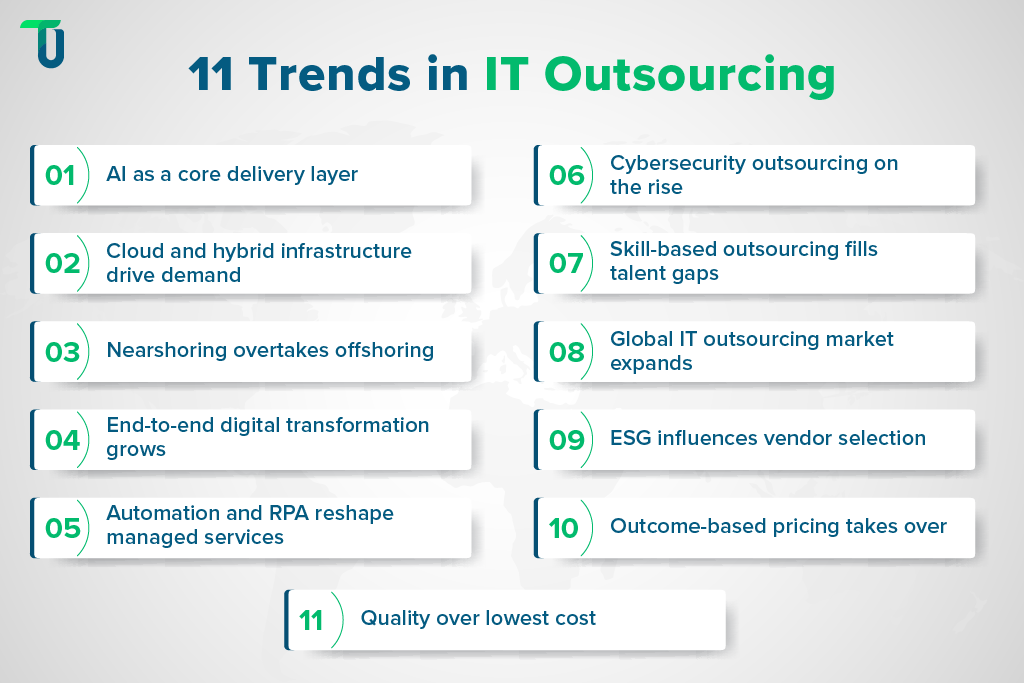
Trend #6: Strategic Rise of Cybersecurity Outsourcing
An important change we might expect is cybersecurity outsourcing becoming strategic rather than reactive. Enterprises will integrate security deeply into IT outsourcing services, supporting software development trends and digital transformation programs.
In other words, cybersecurity will no longer be a separate function but a shared responsibility between vendors and clients, tightly integrated with software development and delivery pipelines.
Common outsourced security services will include:
- Security operations centers
- Threat detection and incident response
- Compliance monitoring and regulatory reporting
- Identity and access management
- Vulnerability assessments and penetration testing
This integration will reduce exposure to cyber risks and regulatory penalties while supporting secure digital transformation outsourcing at scale. Organizations can further strengthen operational resilience with a Scalable ETL solution for risk monitoring systems that centralizes and validates critical enterprise data. Data privacy regulations such as GDPR and CCPA are directly influencing IT outsourcing strategies, making vendor compliance capabilities a critical selection factor. Vendors will play an active role in risk management and compliance outcomes.
Trend #7: Skill-Based Outsourcing Amid Talent Shortages
One of the promising trends we will see is skill-driven outsourcing. Companies will rely on vendors to provide high-demand expertise in AI, cloud, and cybersecurity, reflecting software development trends 2026 in the workforce.
Skill-based outsourcing will focus on:
- Access to expertise in high-demand areas like AI and cloud infrastructure
- Faster team scaling for software development and digital transformation projects
- Reduced pressure on internal hiring and training pipelines
- Capability-driven staffing over traditional role-based assignments
Every technology outsourcing company will need strong internal upskilling programs and adaptable delivery models to stay competitive. Talent availability will become as critical as cost and delivery speed when choosing outsourcing partners. Moreover, outsourcing decisions will increasingly depend on who can deliver the right skills at the right time.
Numbers That Matter: Around 72% of employers report difficulty filling tech roles worldwide. This reinforces the strategic role of outsourcing to access specialized talent at scale.
Trend #8: Continued Growth of the Global IT Outsourcing Market
Another key observation in IT outsourcing and software outsourcing trends is the continued expansion of the global market. Demand for high-value services, managed services, and cloud operations will rise steadily, rather than focusing solely on cost.
Companies will look beyond basic staff augmentation and seek specialized services that support digital transformation initiatives.
Some of the key growth drivers include:
- Rising IT complexity and the need for integrated solutions
- Persistent talent shortages in key technology areas
- Enterprise-scale digital transformation projects
- Adoption of cloud services and hybrid infrastructure
- Focus on sustainability and ESG practices in IT outsourcing
To summarize, global IT outsourcing growth will be driven by specialized services, digital transformation needs, cloud adoption, and sustainability priorities.
Trend #9: ESG and Sustainability in Vendor Selection
A developing trend in the latest trends in software development is sustainability shaping outsourcing choices. Enterprises will not only look at cost or technical capabilities but also at how vendors manage environmental, social, and governance responsibilities.
Common expectations from vendors will include:
- Energy-efficient infrastructure and low-carbon cloud services
- Ethical AI use and responsible automation practices
- Transparent workforce policies and fair labor standards
- Governance frameworks aligned with compliance and sustainability goals
Sustainability and ESG considerations will influence both vendor selection and contract renewals. Providers that fail to meet these standards risk exclusion from enterprise deals.
This shift will also guide cloud service choices as companies seek technology solutions that align with their sustainability and IT outsourcing strategies in 2026.
Trend #10: Outcome-Based Pricing Replacing Hourly Models
One of the more transformative shifts we will see is outcome-based pricing replacing hourly billing. Emerging technologies like AI, RPA, and real-time monitoring tools are making this shift possible by giving both sides clear visibility into delivery performance. Enterprises will tie costs to measurable business results, aligning incentives between clients and vendors.
This shift reflects the broader evolution in IT outsourcing trends, where transparency and accountability drive decision-making. Outcome-based pricing structures will include:
- Performance-linked fees based on delivery outcomes
- Productivity-based pricing tied to measurable milestones
- Service-level tied payments that reward quality and consistency
This model reduces the need for micromanagement while aligning incentives between clients and vendors. Providers take on more delivery risk but gain stronger, longer-term partnerships.
Trend #11: Quality and Predictability Over Lowest Cost
The last major shift in IT trends we will see is that enterprises will prioritize quality and predictability over the lowest price. Reliable delivery and consistent performance will guide IT outsourcing services decisions.
Buyer priorities will focus on:
- Stable delivery teams with consistent expertise
- Clear communication and transparency in progress
- Measurable performance metrics and adherence to SLAs
- Vendors’ ability to handle complex software development trends and digital transformation outsourcing needs
Poor quality can trigger hidden costs through delays, rework, and missed deadlines. Enterprises will look at total value rather than just price.
To sum up, enterprises will favor quality, consistency, and predictable delivery over low cost, focusing on total value, reliable teams, clear communication, and vendors capable of supporting complex software development and transformation needs.
Address Talent Gaps and Complex IT Challenges
TenUp provides custom-built software, cloud, and data services to help your business scale, stay secure, and meet future IT demands.
How Enterprises Can Prepare for 2026 IT Outsourcing Trends
As discussed above, 2026 will be a year full of rapid changes in IT outsourcing and software outsourcing trends. Preparing now helps you manage risks, optimize resources, and stay ahead of the curve. Here are 6 ways to get ready for the IT outsourcing trends in 2026.
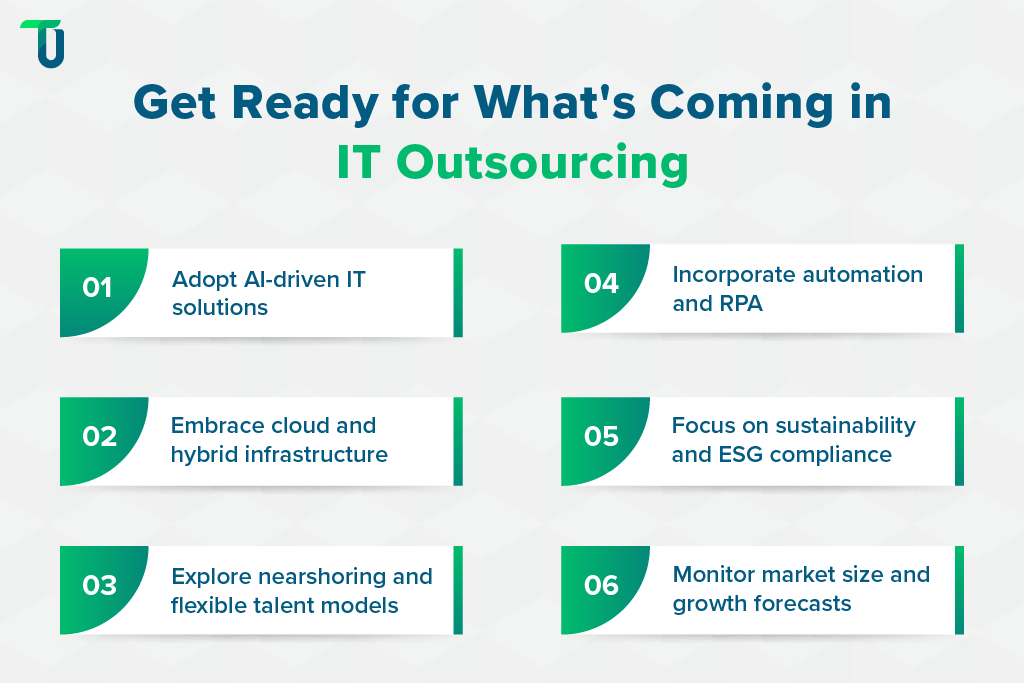
1. Adopt AI-Driven IT Solutions
AI is reshaping IT outsourcing services and software development trends. Enterprises that integrate AI can streamline operations and gain better insights into workloads.
- Use AI for predictive maintenance and performance monitoring
- Automate repetitive tasks to reduce human errors
- Analyze large datasets to identify cost-saving opportunities
Adopting AI-driven tools will boost efficiency and make IT outsourcing more strategic, helping companies align with the impact of AI on IT outsourcing efficiency.
Expert Advice: Enterprises should review their outsourcing strategy early. Focus on partners with proven AI, cloud, and security capabilities. Choose delivery models that support long-term goals, scalability, and predictable outcomes, not short-term cost savings.
2. Embrace Cloud and Hybrid Infrastructure
Cloud adoption continues to drive software development trends in 2026 and digital transformation outsourcing strategies. Hybrid setups give enterprises flexibility and scalability for diverse workloads.
- Move non-critical applications to public cloud platforms
- Maintain sensitive data on private clouds or on-premises systems
- Leverage hybrid models to optimize costs and compliance
Cloud-ready enterprises can better control software development outsourcing cost trends 2026 while ensuring seamless operations across multiple environments.
3. Explore Nearshoring and Flexible Talent Models
Nearshoring reduces risk and improves collaboration. New IT outsourcing strategies 2026 emphasize flexible talent delivery models that balance cost and quality.
- Partner with regional vendors for faster communication and cultural alignment
- Use hybrid teams combining onshore and offshore talent
- Evaluate vendor capabilities regularly to ensure consistent quality
Nearshoring helps enterprises access specialized talent while reducing project delays, aligning with the best IT outsourcing strategies 2026.
4. Incorporate Automation and RPA
Automation and Robotic Process Automation are transforming IT outsourcing services. They reduce operational workload and accelerate software development cycles.
- Identify repetitive IT processes suitable for automation
- Use RPA bots to handle routine reporting and data entry
- Monitor automation outcomes to refine processes continuously
Integrating automation creates measurable efficiency gains, helping companies optimize resources and align with latest trends in software development.
5. Focus on Sustainability and ESG Compliance
Sustainability is becoming a key factor in outsourcing decisions. Enterprises adopting ESG-friendly IT practices improve brand reputation and meet regulatory expectations.
- Choose vendors with green data centers or energy-efficient infrastructure
- Track IT operations’ carbon footprint and report regularly
- Integrate sustainability criteria into contract negotiations
Sustainability-focused outsourcing supports long-term value and positions companies as responsible leaders in digital transformation trends.
6. Monitor Market Size and Growth Forecasts
Understanding market dynamics is essential to plan IT outsourcing services effectively. IT outsourcing statistics 2026 reveal where demand and cost pressures are highest.
- Track emerging regions and industries with high outsourcing growth
- Benchmark vendor performance against market standards
- Use forecasts to plan budgets and resource allocation
Staying informed about market trends ensures enterprises make strategic outsourcing decisions that balance cost, innovation, and scalability.
You May Also Read
Changing Mindsets: Overcoming Cultural Barriers to Digital Transformation
Choosing the Right IT Outsourcing Partner: Key Factors To Consider
Based on the insights shared so far, it's clear that you need a technology outsourcing company that can keep pace with the latest IT trends. Evaluating offshore software development services can help you identify partners with the right technical capabilities, delivery model, and governance practices for long-term success. To make the right choice, focus on the factors outlined below.
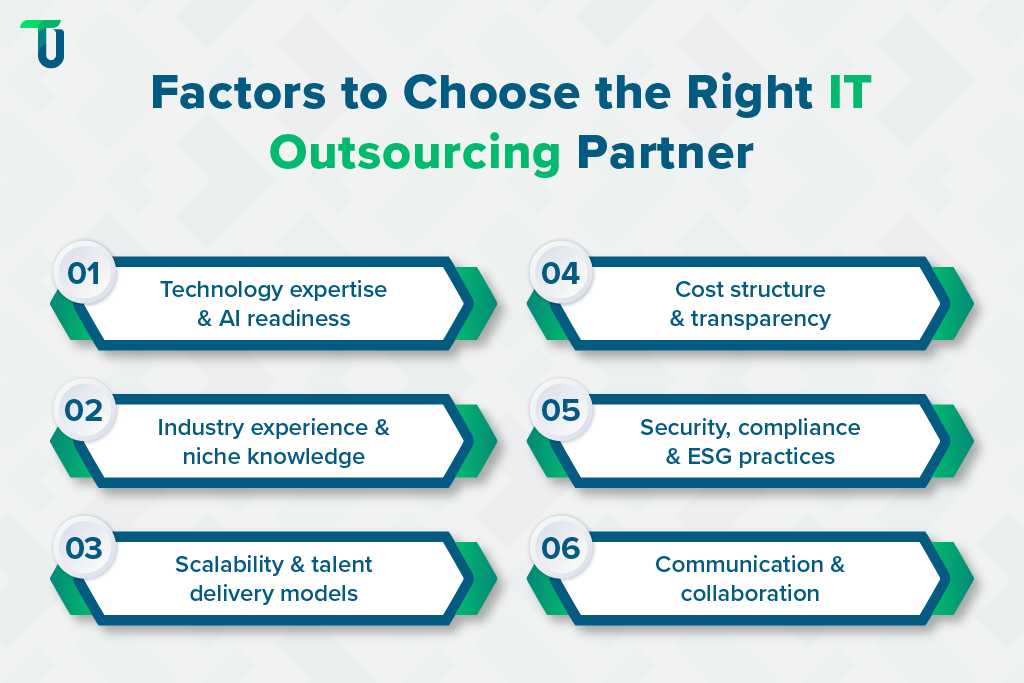
1. Technology Expertise and AI Readiness
Strong technical skills are the first factor to consider. Partners with AI and cloud experience can improve IT outsourcing efficiency and project outcomes. Key areas to check include:
- Experience with AI and automation tools
- Familiarity with cloud services and hybrid infrastructure
- Ability to integrate AI into software development processes
- Track record in digital transformation outsourcing
Selecting a top IT services provider in the USA with proven technology expertise helps ensure your projects adopt the latest IT outsourcing trends efficiently and remain competitive in 2026.
2. Industry Experience and Niche Knowledge
A partner who understands your industry reduces risk and speeds project delivery. Specialized knowledge ensures alignment with digital transformation trends. Consider:
- Exposure to industry-specific IT outsourcing trends
- Knowledge of regulations and compliance requirements
- Past projects similar to your business needs
Industry experience helps your outsourcing partner deliver faster, more compliant, and relevant solutions, aligning with software development trends 2026 and digital transformation initiatives.
3. Scalability and Talent Delivery Models
Flexible teams help projects grow without compromising quality. Scalable talent models align with software development outsourcing cost trends 2026. Look for:
- Access to nearshore and global talent pools
- Ability to scale resources quickly without quality loss
- Effective knowledge transfer and team integration
Scalable talent and flexible delivery models ensure your IT outsourcing partner can handle changing project demands without delays or quality compromises.
4. Cost Structure and Transparency
Predictable pricing helps control spend and plan for long-term IT outsourcing services. Focus on:
- Clear pricing models with no hidden fees
- Alignment of costs with business outcomes
- Options for fixed, subscription, or outcome-based pricing
Transparent and outcome-based pricing allows you to manage costs effectively, ensuring software development and digital transformation outsourcing remain financially sustainable.
5. Security, Compliance, and ESG Practices
Data protection and sustainability are critical in IT outsourcing statistics 2026. A reliable partner should:
- Maintain strong cybersecurity measures and certifications
- Follow local and global regulations
- Support ESG initiatives and sustainability practices
Choosing a partner with strong security and ESG practices safeguards data and supports sustainable IT outsourcing aligned with current industry trends.
6. Communication and Collaboration
Transparent communication ensures projects stay on track. The right partner offers:
- Clear reporting and project management tools
- Dedicated points of contact and structured feedback cycles
- Availability across time zones for smooth coordination
Effective communication and collaboration guarantee project clarity, timely delivery, and alignment with best IT outsourcing strategies 2026.
Future-Ready IT Outsourcing Begins with the Right Partner
The IT outsourcing landscape in 2026 will demand partners who deliver predictable results, deep technical skills, and reliable communication. Two of the major challenges enterprises are likely to face are persistent talent shortages for advanced technologies and the complexity of managing digital transformation across hybrid systems.
This is where we come into the picture. As a reliable technology outsourcing company, TenUp Software Services offers end‑to‑end AI-assisted software development, cloud solutions, and AI development services, among others. Our team of experienced professionals ensures timely delivery, high-quality solutions, and future-ready solutions that give your business an edge over others.
Need Future-Ready IT Outsourcing?
Address talent gaps, hybrid system complexity, and evolving IT demands with our full-suite custom software development services.
Frequently asked questions
What is the difference between IT outsourcing and technology outsourcing?

IT outsourcing delegates specific IT functions like software development and infrastructure to external vendors for efficiency and cost control, while technology outsourcing is broader, covering R&D, product engineering, and digital transformation. In 2026, the line between both is blurring as enterprises expect vendors to handle operations and transformation under one partnership.
Is IT outsourcing still cost-effective in 2026 or has the value proposition shifted?
IT outsourcing remains cost-effective in 2026, but the value proposition has shifted. Enterprises now prioritize access to specialized AI, cloud, and cybersecurity talent over lowest-cost labor. Outcome-based contracts are replacing hourly models, meaning value is measured by business results: faster delivery, reduced downtime, and innovation speed.
How long does a typical IT outsourcing contract last in 2026?
IT outsourcing contracts in 2026 typically range from 3 to 5 years, though the average deal length has shrunk to roughly 3.5 years as AI and cloud advancements push enterprises toward more flexible, outcome-based agreements. Project-based work runs 2 to 6 months, while managed services and dedicated team contracts extend to several years depending on scope.
What are the biggest risks of IT outsourcing and how can enterprises mitigate them?
The biggest IT outsourcing risks include data security breaches, vendor lock-in, hidden costs, and poor delivery quality. Enterprises can mitigate these by requiring compliance certifications like ISO 27001, defining strict SLAs with performance penalties, maintaining full IP ownership, and treating vendors as strategic partners rather than transactional suppliers.
Which countries are emerging as top IT outsourcing destinations in 2026?
India remains the dominant destination, while Vietnam, Mexico, and Poland are fast emerging as top alternatives. In 2026, enterprises are choosing destinations based on specialized talent and proximity, not just price.
What should be included in an IT outsourcing SLA in 2026?
A modern IT outsourcing SLA should include AI performance metrics, cybersecurity compliance standards like GDPR and ISO 27001, outcome-based KPIs tied to business results, cloud uptime guarantees of 99.9% or higher, and clear penalty clauses with real-time reporting. In 2026, SLAs are strategic frameworks built around shared accountability, not just penalty documents.
How is generative AI changing the role of IT outsourcing vendors?
Generative AI is shifting vendors from labor-based models to value-driven partnerships, boosting productivity by 15–30% through automated coding, testing, and monitoring. In 2026, the most competitive vendors are acting as AI implementation partners, not just service providers.
How do enterprises measure ROI from IT outsourcing engagements?
Enterprises measure IT outsourcing ROI by comparing total benefits against total costs, tracking cost savings, time-to-market improvements, delivery speed, and system reliability. In 2026, outcome-based contracts make ROI measurement more structured by tying vendor payments directly to measurable business results rather than hours billed.
Share the Article


