


The cost of building an MVP has dropped significantly. Development timelines on well-scoped projects have compressed by 40 to 55%, according to McKinsey and GitHub. These gains are real. What they measure is the cost of building software. What they do not measure is the cost of owning it.
For enterprise buyers evaluating an AI-assisted software development workflow, that gap is where most engagements create unexpected cost. This blog covers three economic realities enterprise buyers need to know before committing to an AI-assisted engagement: where cost compression is real, where it becomes margin for the development partner, and what total cost of ownership looks like across a full application lifecycle.
The economic trade-offs discussed here are built on the governance considerations explored in How AI-Assisted Development Changes Software Delivery for Enterprises.
Vibe Coding Reduces Build Cost, Not the Cost of Owning What Gets Built
Vibe coding has compressed the cost of building software faster than any development methodology in the past three decades. The distinction between the cost of building software and the cost of owning it is what determines whether enterprise buyers actually capture the savings.
1. What the Productivity Numbers Actually Measure
McKinsey's research on developer productivity documents 20 to 45% productivity gains on clearly scoped tasks. GitHub's Octoverse data shows task completion up to 55% faster.
Neither measures delivery quality, post-launch defect rates, or maintenance cost trajectory. A development partner quoting these figures as evidence of cost reduction is measuring the input, not the outcome. Speed of generation is not equivalent to reduction in total engagement cost.
2. The Build vs. Buy Redefinition: The Hidden Risk for Enterprise Buyers
Vibe coding has made building bespoke micro-tools economically competitive with buying enterprise SaaS for specific niche problems. For enterprise buyers, this changes the make-or-buy calculation on internal tooling, workflow automation, and custom integrations.
As build costs drop, the governance and maintenance cost of what gets built becomes the dominant variable, not the development cost. Enterprises that build more because building is cheaper, without upgrading their governance infrastructure, accumulate technical debt faster than the cost savings justify.
3. Where the Cost Reduction Is Real and Where It Stays With the Development Partner
When a development partner's vibe coding workflow compresses delivery time by 40%, one of two things happens: the client receives a lower invoice, or the efficiency is absorbed into the development partner's cost structure under the existing rate.
Time-and-materials pricing is structurally misaligned with AI-assisted delivery:
- It prices hours worked, not software delivered, creating no structural incentive to pass AI efficiency to the client
- Every hour AI saves reduces billable output, so the pricing model works against cost transparency
Require outcome-based or fixed-scope pricing on AI-assisted engagements.
TenUp's Take: A development partner whose workflow is governed well enough to be predictable will be willing to price on outcomes.
Where AI-assisted delivery reduces cost for enterprise buyers:
- MVP and prototyping phases with well-scoped requirements
- Greenfield development on modular, API-first architectures
- Legacy system documentation and onboarding acceleration
- Automated test generation on well-specified features
Total cost of ownership after delivery is rarely scoped at the engagement stage, because it is genuinely difficult to estimate before the build begins.
The Total Cost of Ownership Problem Enterprise Buyers Must Evaluate
For enterprise buyers, whether an AI-assisted engagement delivers economic value or defers it depends entirely on what gets measured and when.
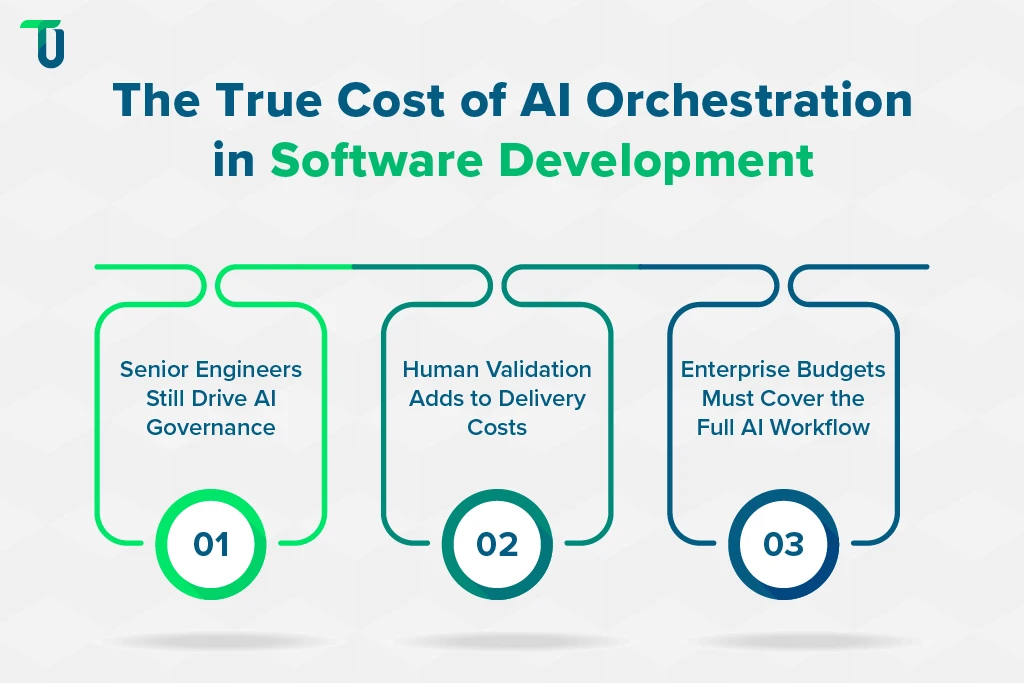
1. Where AI-Assisted Delivery Shifts Cost Rather Than Reduces It
Not every project type benefits from AI generation economics. Three categories consistently shift cost rather than reduce it:
Complex integrations with proprietary legacy systems: AI tools trained on public data produce code that conflicts with proprietary business logic where behavioral rules are embedded in institutional knowledge rather than documented specifications. Rework cycles from that conflict cost more than the generation speed saved.
Security hardening and compliance validation: Georgian's engineering analysis documents a consequential dynamic: the cost to produce software is decreasing, but the cost to defend against AI-generated attack surfaces is increasing in parallel. Snyk's research suggests that AI-generated code contains 40 to 65% security vulnerabilities depending on the model. Security validation of AI-generated code is not cheaper than security validation of human-written code. It is often more expensive because the failure patterns are less predictable.
Rework cycles from context loss at scale: AI performs well on isolated, well-scoped modules. In large, interdependent enterprise codebases, context loss produces code that passes unit tests and fails in production. The rework cost is invisible at the proposal stage and significant at the invoice stage.
2. The 18 to 36 Month Maintenance Cliff
Ungoverned AI-assisted development's most expensive consequence appears 18 to 36 months after delivery, not at handover. AI-generated code without traceable architectural decisions and human-readable documentation creates a maintenance cost trajectory that exceeds traditionally developed systems within that window.
Teams maintaining AI-generated code they did not author, without documentation of why architectural decisions were made, spend significantly more time on every change than teams with clear decision trails. Atlassian's research on technical debt documents this compounding pattern in AI-assisted development contexts.
This cost materialises after delivery, not during it, which is why it rarely factors into engagement decisions.
3. The Right Measurement Is TCO, Not Time-to-Delivery
Most engagement proposals lead with time-to-delivery. Gartner consistently frames TCO as the correct evaluation framework for enterprise software decisions. A delivery that is 40% faster but generates 60% higher maintenance cost over three years is not an economic win. It is a cost deferral with interest.
The next question is why most AI-assisted software development workflows make the TCO problem worse, and that is a process failure, not a technology failure.
Planning an AI-assisted software project?
Let's discuss how delivery governance, architectural discipline, and long-term maintainability fit into your evaluation criteria.
Why Most Vibe Coding Workflows Create Cost Before They Reduce It
Ungoverned AI-assisted development workflows do not reduce costs. They shift costs downstream into rework and integration failures that compound with every sprint that runs without a structured process.
1. The Repeatable Process Problem and Its Organizational Cost
AI-generated code is only economically valuable if it can be maintained and extended by teams who did not write it. Without a repeatable workflow governing how AI output enters the codebase, every sprint produces technically functional but organizationally unmaintainable code. That difference surfaces in every maintenance cycle after the engagement ends.
2. Prompt Dependency as a Cost Predictability Risk
When project success depends on prompt quality rather than engineering practices, delivery outcomes are not repeatable. What works in sprint three may not work in sprint eight as codebase complexity grows and prompt construction drifts from the original context.
Cost predictability is the primary financial argument for AI-assisted development. It disappears when workflow is prompt-dependent rather than specification-driven. An engagement that cannot be estimated cannot be priced on outcomes, transferring delivery risk entirely to the buyer.
3. ALM Integration Challenges and Their Hidden Cost
Most enterprise ALM frameworks were designed for human-speed development. Integrating a vibe coding workflow without restructuring them creates friction that eliminates velocity gains before they reach the client.
IDC's analysis of the process implications of vibe coding documents a consistent pattern: teams retrofitting AI-speed generation into human-speed governance infrastructure spend time managing the gap rather than delivering software.
Gartner frames this as a governance architecture problem requiring ALM infrastructure redesigned for AI-speed output volumes.
4. AI Tool Proliferation and the Fragmentation Cost
GitHub Copilot, Cursor, Replit, and other AI coding tools each carry their own workflow assumptions. Teams using multiple tools without a unified workflow standard create fragmented processes where output quality varies by tool, by engineer, and by sprint.
Quality inconsistency makes estimation, pricing, and delivery planning structurally harder. Sprint forecasting loses its reliability when the same prompt produces different implementation quality depending on which tool ran it and who constructed it.
Workflow chaos is a methodology problem whose cost compounds with every unstructured sprint.
What the Shift From Code Writing to AI Orchestration Actually Costs
AI-assisted workflows do not reduce the need for senior engineering judgment. They redistribute it.
1. Why Orchestration-Capable Engineers Cost More, Not Less
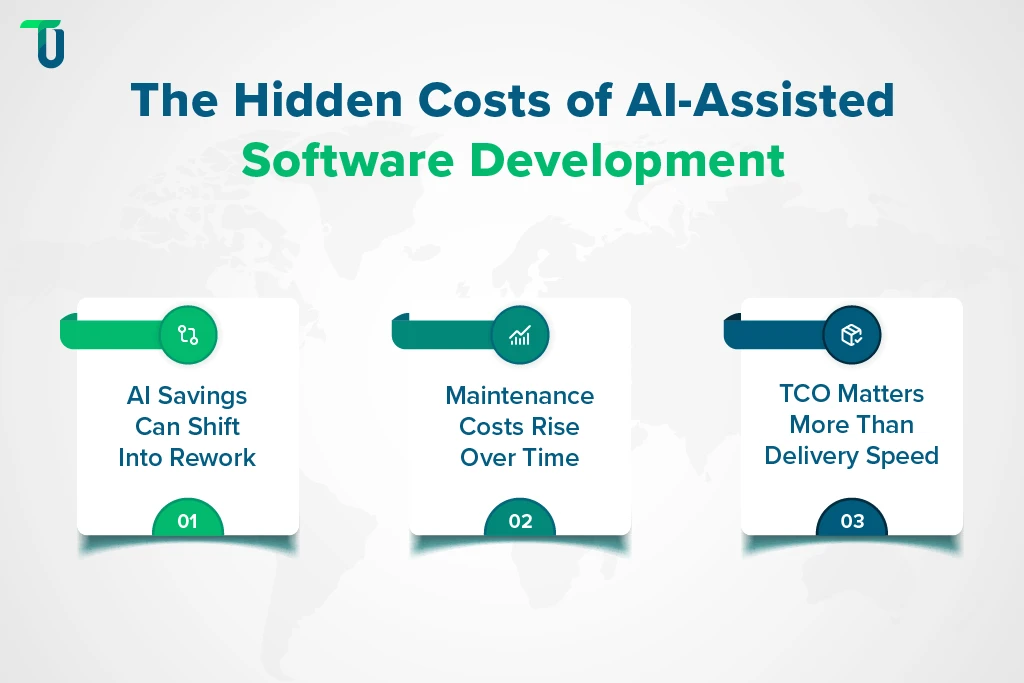
While a reduction in headcount is real, the shift from implementation to orchestration moves the economic reality in the opposite direction. Engineers capable of governing AI output at scale are the most experienced on the team, and they command rates that reflect it.
AI output volume scales without a corresponding reduction in governance requirement. The governance cost does not compress the way generation cost does. DORA's 2024 State of DevOps research confirms that high-performing engineering teams invest more in review and governance infrastructure as AI adoption increases, not less.
2. The Human-in-the-Loop Validation Cost Most Budgets Ignore
Every AI-generated output requires human validation before it is production-safe. IBM confirms that validation cost scales with output volume and must be factored into any economic model of AI-assisted delivery.
When validation is underfunded, defects reach production.
3. What Enterprise Buyers Should Scope In AI-Assisted Development Engagements
Four cost categories appear in every well-governed AI-assisted engagement but are rarely scoped at the outset:
Prompt engineering capacity: Constructing prompts that produce consistent, high-quality output across a full engagement requires domain knowledge, architectural awareness, and iterative refinement. It is skilled work, and it is not performed by junior engineers.
Review gate infrastructure: CI/CD pipelines must be restructured for AI-speed output volumes. This is a one-time capital cost most development partners do not include in engagement pricing because it is infrastructure investment, not billable delivery work.
Intentional documentation: Architectural decision records must be produced alongside AI-generated code, not substituted by auto-generated outputs. Scope this as a delivery requirement before the engagement starts.
Post-engagement maintenance allocation: Budget for the period when internal teams maintain AI-generated code without the development partner’s support. Its cost is determined by documentation quality and code traceability established during the engagement.
The enterprises capturing real value budget for the full workflow cost, not just the generation speed.
What Structured Vibe Coding Economics Look Like When the Workflow Is Governed
A governed AI-assisted software development workflow changes the economic profile of a vibe coding engagement from unpredictable to plannable. The specification stage is where that predictability is created.
1. What Governed Specification Produces in Economic Terms
A zero-ambiguity specification defines the constraints within which AI generates. The economic output is specific: predictable scope, bounded rework cost, and measurable delivery milestones that make fixed-scope pricing viable.
As covered in TenUp's guide to how vibe coding is redefining custom software development services, CI/CD integration and DevSecOps governance are the infrastructure that makes specification-driven delivery repeatable at scale.
| SDLC Stage | Governed Workflow Economic Impact | Ungoverned Workflow Economic Risk |
|---|---|---|
| Planning and Specification | Misalignment caught before code is written, rework cost near zero | Misaligned specs generate wrong code at AI speed, rework cost compounds |
| Development | Output volume increases without proportional cost increase | Generation speed creates review backlogs that eliminate velocity gains |
| Testing and QA | Defect cost shifts left, post-launch rework decreases | AI-speed output overwhelms human-speed QA, defects reach production |
| Deployment | Handover cost reduces, internal team ramp-up accelerates | Auto-generated documentation leaves internal teams unable to maintain what was built |
| Maintenance and Ops | Long-term cost predictable and bounded | Technical debt compounds, maintenance cost exceeds original development cost |
2. The Build vs. Buy Recalculation for Enterprise Custom Software
As vibe coding drops build costs, the build vs. buy calculation shifts. The correct calculation is total cost of ownership of custom-built software versus enterprise SaaS, across maintenance, integration, upgrade cycles, and vendor dependency costs over the full application lifecycle.
For complex enterprise needs with proprietary workflows, governed AI-assisted development now competes economically with enterprise SaaS on a TCO basis in ways it could not two years ago. Gartner supports this shift: as build costs compress and SaaS licensing costs escalate, the crossover point at which custom development becomes the economically rational choice has moved significantly closer for mid-to-large enterprise requirements.
The calculation requires one input most enterprise buyers lack: a governed delivery model with a predictable cost structure.
3. What Outcome-Based Pricing Signals About a Development Partner's Workflow
A development partner offering fixed-scope or outcome-based delivery structures the commercial relationship around output, not hours. That model passes AI efficiency to the client and makes governance quality directly visible.
A development partner on time-and-materials has no structural incentive to optimize delivery speed or quality. The pricing model is a more reliable signal of workflow maturity than any proposal document.
The Economic Decision in Front of You
Vibe coding changed the cost of building software. The buyers capturing real economic value from it made one decision differently from the ones absorbing unexpected costs: they required their development partner to structure the engagement around outcomes, specify zero-ambiguity requirements before generation began, and document architectural decisions as a delivery requirement.
At TenUp Software Services, we apply AI-assisted software development through fixed-scope outcome delivery, specification-driven AI generation, and documentation as a standard part of engineering delivery. Explore our AI-powered project case studies to see how this approach has been applied across enterprise engagements.
Evaluating whether to build custom software or adopt SaaS?
Let's discuss your requirements, engineering constraints, and long-term business goals before deciding on the right approach.
Frequently asked questions
What is a vibe coding workflow and how does it change software development economics?

A vibe coding workflow is when developers describe desired functionality in natural language and AI generates the implementation, compressing build time and cost upfront. The economic shift that matters isn't cheaper builds; it's cost migrating downstream. Ungoverned AI-generated code typically raises total cost of ownership within 18 to 36 months of delivery.
How much do individual vibe coding tools like Cursor, Replit, or Copilot actually cost per month?
Base subscriptions for Cursor, Replit, and GitHub Copilot run $10 to $20 a month, each bundling roughly $10-25 in usage credits. Heavy agent-based work burns through those credits fast, often pushing real costs to $39-$200 a month via higher tiers like Copilot Pro+ or Cursor Ultra.
Is vibe coding secure enough for production or enterprise applications?
No, not without review. Across 5,600 vibe-coded apps, researchers found 2,000+ vulnerabilities, and 53% of teams shipping AI-generated code discovered security issues only after deployment. In 2026, vibe-coded platform Moltbook exposed 1.5 million auth tokens after unreviewed AI code embedded credentials directly in source files.
Does AI-generated code create more technical debt than code written by developers?
Yes, and it's measurable. A Carnegie Mellon study of 806 repositories found AI-adopting teams saw code complexity rise 9%, with a 100% complexity increase linked to a 64.5% drop in monthly code shipped. A separate ICSE 2026 meta-analysis of 101 studies found AI-assisted workflows accumulate technical debt roughly 3x faster than traditional development.
Will vibe coding replace software engineers, or just change what they do?
No. It redistributes the work, not eliminates it. Engineers shift from writing code to reviewing, validating, and architecting AI output. DORA's 2024 State of DevOps research found high-performing teams invest more in governance and review as AI adoption rises, not less, so orchestration-capable engineers command higher rates.
What's the actual difference between "vibe coding" and using an AI coding assistant like Copilot?
Copilot is tool-assisted development: you write the logic, and Copilot autocompletes lines you still review. Vibe coding is different: you describe outcomes in natural language and accept AI output largely unreviewed. Google's Addy Osmani frames it exactly this way: vibe coding skips review; AI-assisted engineering keeps it.
How much does a data breach typically cost a company?
IBM's 2025 report puts the global average breach cost at $4.44 million, down 9% from 2024's $4.88 million; the first decline in five years. Breaches involving ungoverned AI tools still cost roughly $670,000 more, which is why unreviewed AI-generated code carries real financial risk, not just technical risk.
How do you measure code quality when a large share of a codebase is AI-generated?
Measure AI-generated code quality by tracking code complexity, static analysis findings, code churn, and test coverage growth alongside delivery metrics. As AI accelerates code production, test coverage should grow proportionally with the codebase. If code volume outpaces testing, review quality, or defect rates, technical debt and production risk are increasing.
Share the Article


