


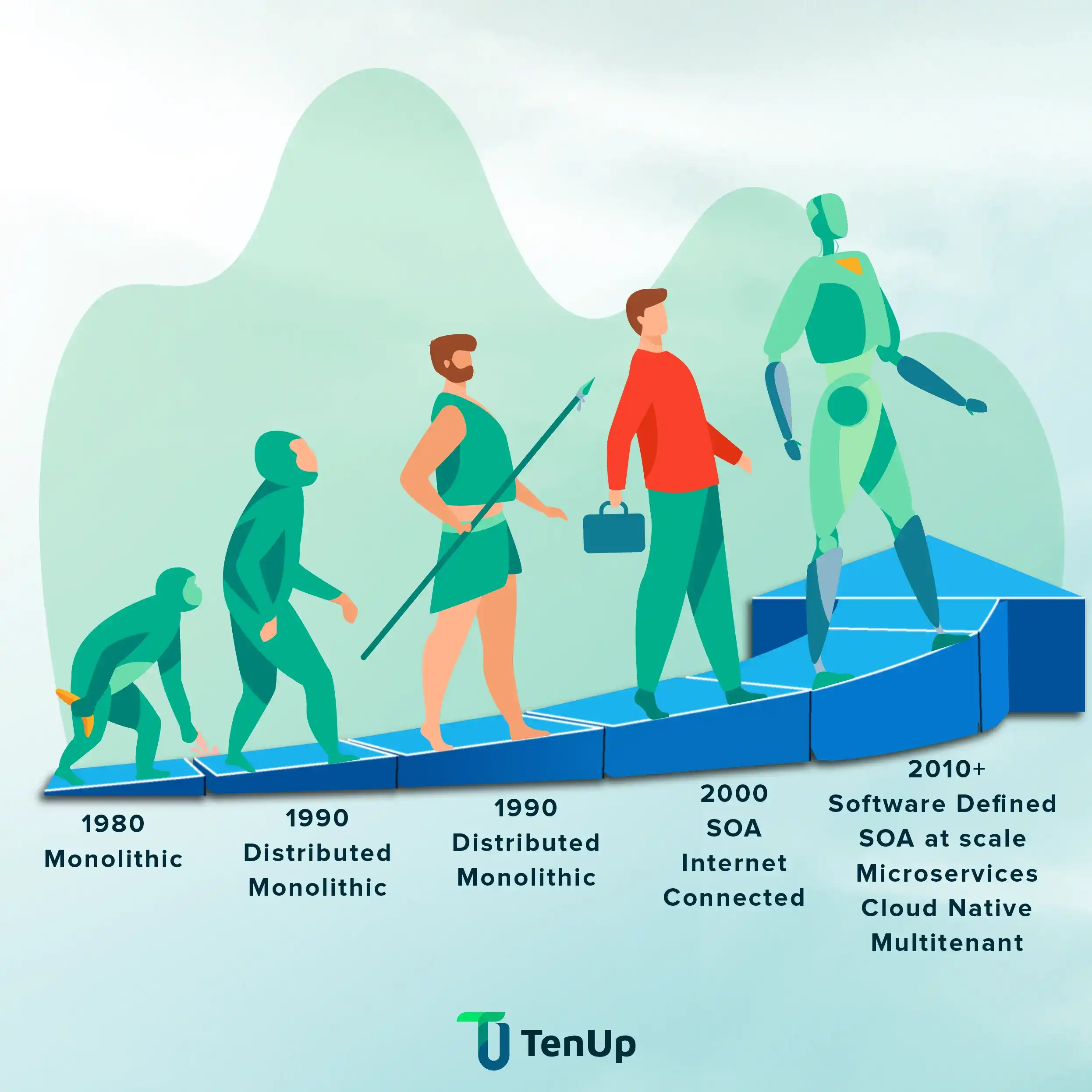
As businesses traverse through their digital transformation journey to survive the race for the best, fastest and most relevant, technology and architectural choices become an important element of the overarching business strategy. According to McKinsey, nearly 70% of large-scale digital transformation initiatives fail, often due to challenges related to legacy systems, fragmented architectures, and poor alignment between technology and business strategy. This highlights why choosing the right application architecture model is critical for successful modernization.
To support the modernization and transformation initiatives, modern application architecture models have evolved significantly, shifting toward more scalable, cloud-ready, and resilient design patterns. The application design focus is now more user centric, agile and stateless. Choosing the right application architecture for your business depends entirely on your business goals. In this blog, we will take a look at the architecture choices and their evolution over time.
Application Architecture Explained: Models, Structure, and Evolution
Application architecture defines the structural design of a software application—how its components are organized, how they communicate, how data flows, and how the system scales and evolves over time, all of which are shaped by the evolution of application architecture in response to modern cloud and scalability demands. It provides a blueprint that guides development teams in building applications that are reliable, maintainable, and aligned with business objectives.
- How application components are structured and connected
- How data is processed, stored, and shared
- How the system scales, performs, and handles failures
- How changes can be introduced without disrupting the system
An application architecture model represents a standardized approach to designing and structuring applications. Each model focuses on addressing specific challenges, such as scalability, deployment complexity, data consistency, and operational efficiency. As business needs and technologies evolve, these models also evolve, moving from tightly coupled monolithic systems to more modular, distributed, and cloud-ready architectures, a transition often framed as Monolithic vs microservices architecture in enterprise modernization discussions.
Legacy Monolithic Architecture: Structure, Benefits, and Limitations
Traditional monolithic architecture is the practice of building applications with a single code base and various modules like websites. Monolithic applications follow a monolithic architecture model where all components, UI, business logic, and data access are tightly coupled and deployed as a single unit.
This style uses a single build system that creates the entire application and dependency. Monolithic architecture is useful for teams that are in the early stages of building or creating an untested product. Many large and well known businesses started with monolithic applications. For example, the eCommerce company Etsy initially used a monolithic architecture for a long time before they evolved to a modular, more service‑oriented structure as scale and complexity grew.
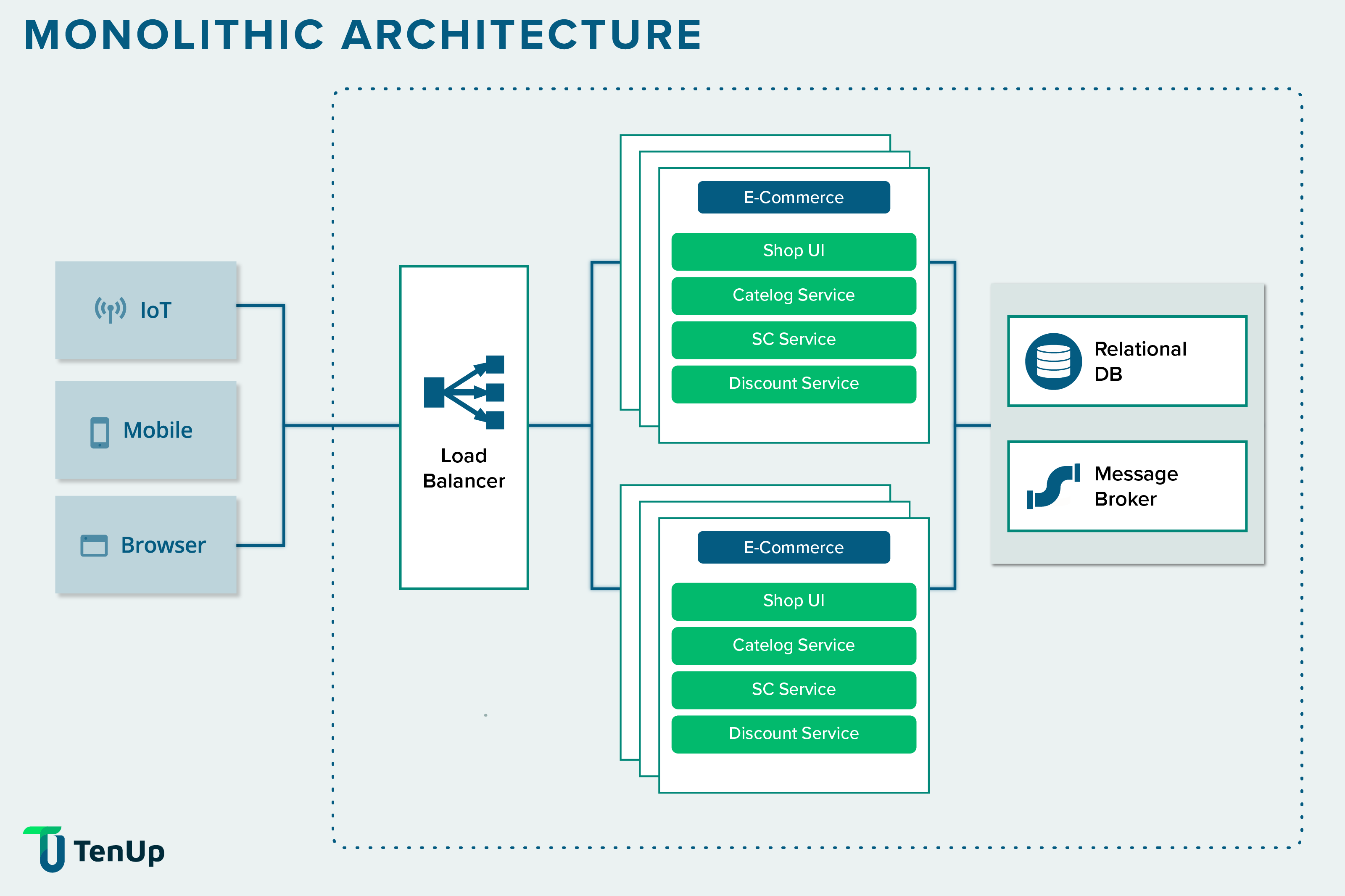
At a high level, application architecture typically defines:
Within the monolithic architecture approach, you have one-tier, two-tier and three tier architectures.
-
One -Tier:
This approach involves putting all the necessary components of an application on a single server or platform. In contrast to multi-tiered architecture where presentation, business and data layers are housed separately.
- Two Tier:
In a two-tier design, the user interface is stored on the client system while the database is saved on the server. This method has several advantages such as better performance, ease of application design etc
- Three-Tier Architecture:
In the 3-tier approach, middleware sits between client and server machines. If a user needs specific information from the server, then the user submits a request that is received by an intermediate layer. The main benefit of this approach is that each tier runs its own infrastructure, it can be developed concurrently by separate development teams and updated or scaled as required without impacting other tiers
- N-Tier Architecture:
This is an approach that uses different components, organized in tiers that provide dedicated functionality. It is similar to a three-tier design except that the number of servers is expanded and used in different tiers to separate business logic.
This monolithic design simplified early development but limited flexibility, making it harder for applications to evolve, one of the key drivers behind enterprise application architecture modernization. The tiered architecture approach is frequently called legacy or monolithic architecture. For several decades, three‑tier architecture was one of the most widely adopted approaches for client‑server applications.
Monolithic architecture is still used in some domains (e.g., small or tightly‑coupled systems), but it predates public cloud and mobile‑first landscapes, which favor more modular designs. Monolithic architecture can still be used but it poses some constraint in terms of adaptability and flexibility.
Modern architectural preferences have evolved starting from Service-Oriented Architecture to cloud-native, event-driven, and multi-tenant models. Here’s how they have evolved.As application evolution became necessary to support scalability, reuse, and faster change, enterprises began moving away from monolithic models toward service-based application architecture.
Is your application architecture aligned with how your business needs to scale?
TenUp helps design and modernize application architectures that are scalable, resilient, and aligned with real business outcomes.
Service-Oriented Architecture (SOA): Reuse, Integration, and Enterprise Scalability
Service Oriented Architecture (SOA) is a development model that builds applications composed of discrete and loosely coupled software agents to perform the desired function. Service Oriented Architecture (SOA) represents a key stage in application architecture evolution, enabling loosely coupled services that improve integration, reuse, and enterprise-scale flexibility.
The idea is to make software components reusable with the help of service interfaces. These interfaces use common communication standards such that they can be rapidly incorporated into new apps without performing deep integration every time.
Key characteristics of Service-Oriented Architecture
- Builds applications using discrete and loosely coupled software agents
- Enables reuse of software components through service interfaces
- Uses common communication standards for integration
- Improves integration, reuse, and enterprise-scale flexibility
Each service in the SOA contains the code and data integrations needed to fulfil a complete, discrete business service. For example, calculating a monthly loan payment, processing a mortgage form, or checking a customer’s credit information.
While services can be built from scratch, they are often created by exposing functions from legacy systems of record as service interfaces.
These are typically exposed with standard network protocols such as SOAP (simple object access protocol) or REST to send requests to read and change data. SOAP messages are typically larger and more bandwidth‑intensive than REST‑style APIs using JSON, making SOAP relatively heavier.
SOA represents an important stage in the evolution of application architecture. Before SOA, many integrations were point‑to‑point and tightly coupled, creating integration spaghetti. SOA helped by standardizing service interfaces and reducing the need for one‑off integrations. Making those functions available through SOA eliminates the need to create the integration each time.
Microservice Architecture: Building Scalable and Independently Deployable Applications
For many years, microservice architecture or microservices has been the buzzword in application architecture. It is a model that structures a single application as a series of loosely coupled services. Unlike monolithic apps that are designed as a single, indivisible unit, microservice apps have multiple, independent components that work together with the help of APIs.
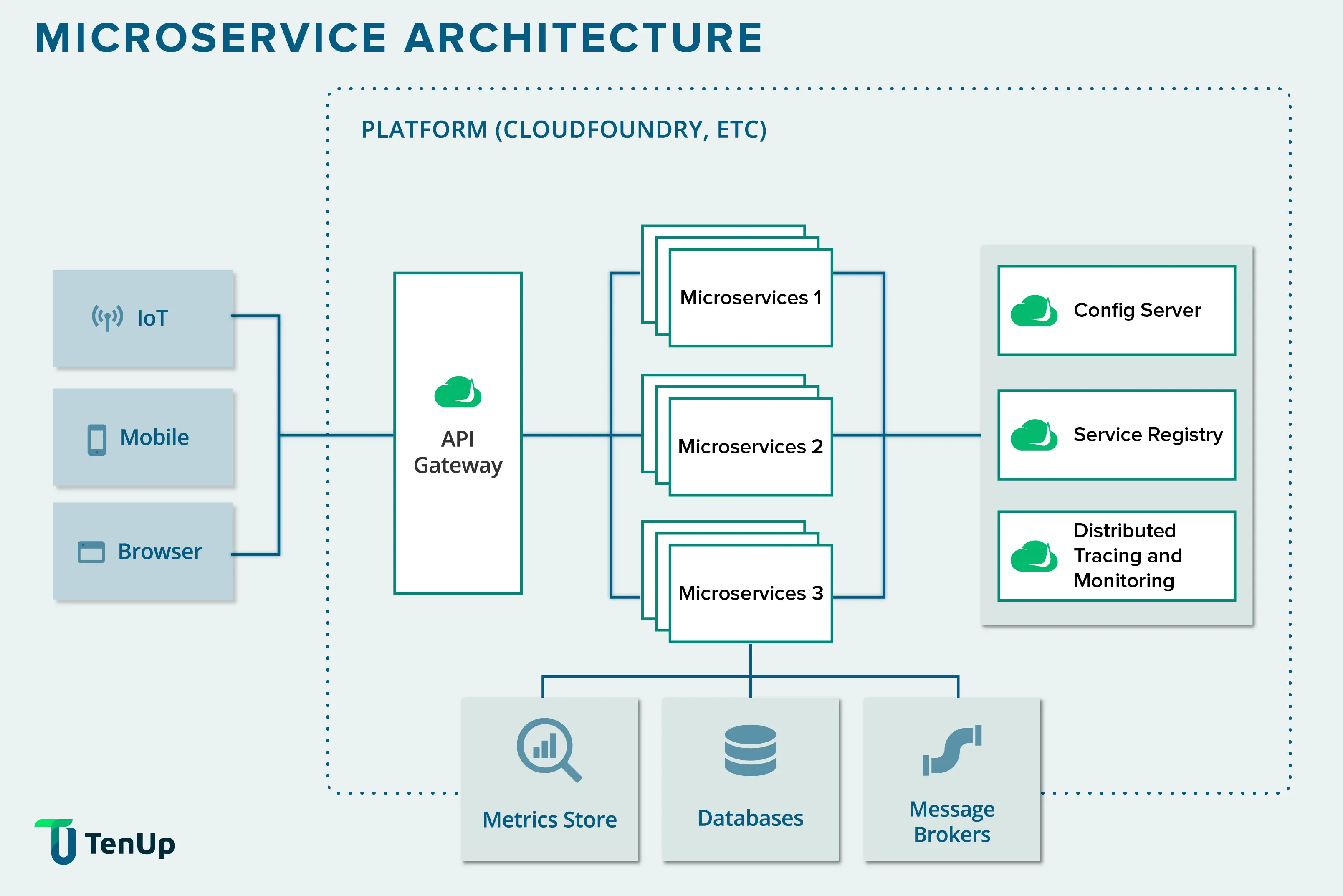
Microservices are a core pillar of modern application architecture models, allowing organizations to build scalable, independently deployable services aligned with agile and DevOps practices.
Key characteristics of Microservice Architecture
- Structures a single application as a series of loosely coupled services
- Uses multiple, independent components instead of a single indivisible unit
- Relies on APIs for communication between services
- Enables scalable and independently deployable services
For instance, an eCommerce app is developed with this approach. Each microservice in the app is designed for a single business capability, from shopping cart, search, customer review, payment, etc. Each component is a separate service.
The beauty of this approach is that each service may be written in a different programming language, deployed using different infrastructures, and managed by separate development teams.
The services communicate with each other using a lightweight protocol. Some commonly used protocols include REST and gRPC. While N‑tier separates concerns across presentation, business, and data layers, microservices apply a similar idea of separation at the service level, often using patterns such as Sidecar, Ambassador, and Adapter to encapsulate cross‑cutting concerns.
Cloud-Native Architecture: Containerized Microservices for Scalability and Resilience
Cloud Native apps expand the multiservices paradigm further by using discrete, reusable components (microservices) to integrate in a cloud environment, making cloud-native and microservices architecture a preferred choice for transforming legacy applications. Here, microservices act as building blocks and are often packed in containers such as Docker, Kubernetes, AWS ECS/EKS, Azure Container Service, etc.
Cloud-native design represents a Cloud-native architecture optimized for elasticity, resilience, and continuous delivery in modern distributed environments.
Core building blocks of cloud native architecture
- Discrete, reusable components based on microservices
- Containerized services using Docker, Kubernetes, AWS ECS/EKS, Azure Container Service etc.
- Cloud-based environments designed for distributed systems
Since containers are smaller, resource-efficient, and portable compared to virtual machines, containerized microservices have become the default units of modern cloud-native apps.
Role of containers and orchestration
Just like containers boost developer productivity, orchestration tools are leveraged by organizations to optimize their DevOps and operations investment.
In addition to lower operation costs and better scalability, orchestration helps reduce friction, resulting in autonomous management and a consistent operating experience across cloud servers.
Some of the most well-known container orchestration services include:
- Kubernetes
- Apache Mesos
- Docker Compose
Cloud‑native applications often use containerized services, microservices‑style patterns, and DevOps practices, orchestrated by platforms such as Kubernetes, to achieve elasticity, resilience, and rapid deployment.
Cloud Native vs Traditional Applications
How do cloud native apps different from traditional apps that run in your data centres?
Traditional apps that weren’t built for cloud compatibility are unable to leverage all the benefits of the cloud, such as:
- Storage
- Queuing
- Caching
Key characteristics of cloud native concepts
Some of the characteristics of cloud native concepts include:
- Disposable infrastructure and disposable architecture
- Isolation
- Scalability
- Polyglot cloud
- Full-stack teams that are self-sufficient
To sum it up, cloud-native uses a highly flexible approach, building on microservices to add to the agility and continuous improvement of apps.
Cloud Native architecture also uses methodologies such as 12 Factor apps for building scalable and performant, independent, and resilient enterprise applications. The 12-factor app approach became very popular as it fits well into the cloud-native paradigm.
Serverless Architecture: Function-Based Design Without Infrastructure Management
Serverless architecture is also known as serverless computing or function as a service. It is a design model that builds and runs applications or services without having to manage infrastructure.
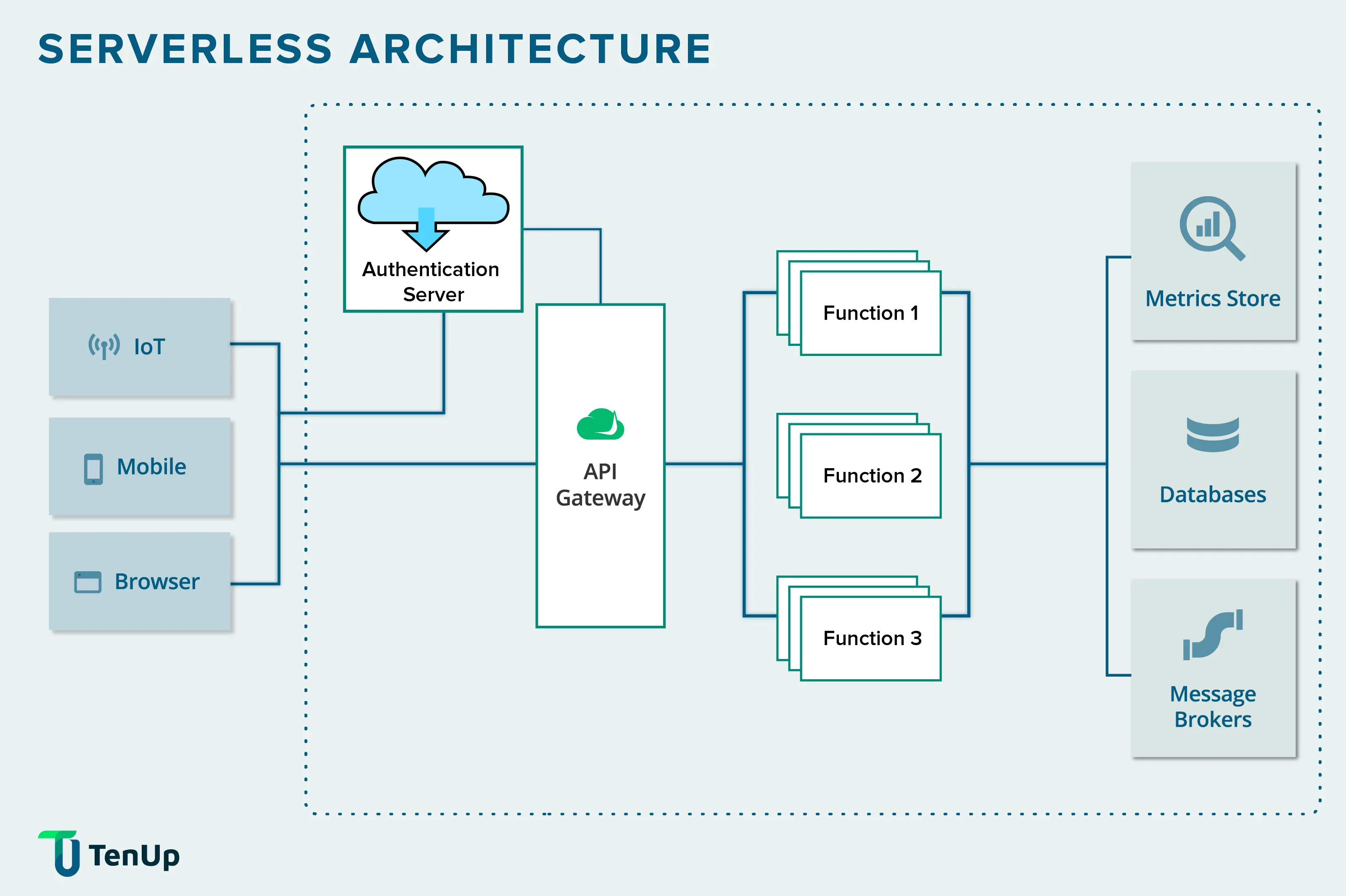
The application still runs on servers, but all the server management is handled by third-party Backend as a Service (BaaS) providers such as Amazon Web Services.
How serverless architecture works
In a serverless architecture:
- Applications are separated into individual functions
- Functions are invoked and scaled independently
- Infrastructure management is abstracted by the cloud provider
The benefit of using serverless architecture is that developers can focus on their core activities instead of concerning themselves with managing or operating servers or runtimes.
Benefits of serverless computing
- Reduced operational overhead
- No need to manage servers or runtimes
- More time spent on innovation and product development
- Applications can scale efficiently
Serverless is especially attractive for workloads that are event‑driven, short‑lived, and variable in scale, though it can also be used for complex applications with careful design.
When serverless architecture is used
- Suitable for applications with a limited number of functions
- Can still be used for more complex applications, but requires a different design approach
Event-Driven Architecture: Real-Time Communication with Decoupled Services
Event-driven architecture leverages events to trigger and communicate between decoupled services. This approach is common in modern apps that are designed using microservices to handle real-time events to maintain consistency across services.
An event can be any update or change in state, such as an item being placed in a shopping cart or a payment received.
Event-driven systems support evolutionary architecture by allowing applications to change incrementally without disrupting existing services.
Core components of event-driven architecture
Event-driven architectures have three main components:
- Event producers
- Event routers
- Event consumers
The producer publishes an event to the router, which pushes the events to the consumers. Producer and consumer services are decoupled, enabling easy scalability, updates, and deployment.
Benefits of event-driven architecture
The main benefit of an event-driven application is that businesses achieve a flexible system that adapts to changes and makes decisions instantly.
It also enhances customer experience responses and processes streaming data in real time.
Multi-Tenant Architecture: Shared Infrastructure with Logical Isolation for SaaS
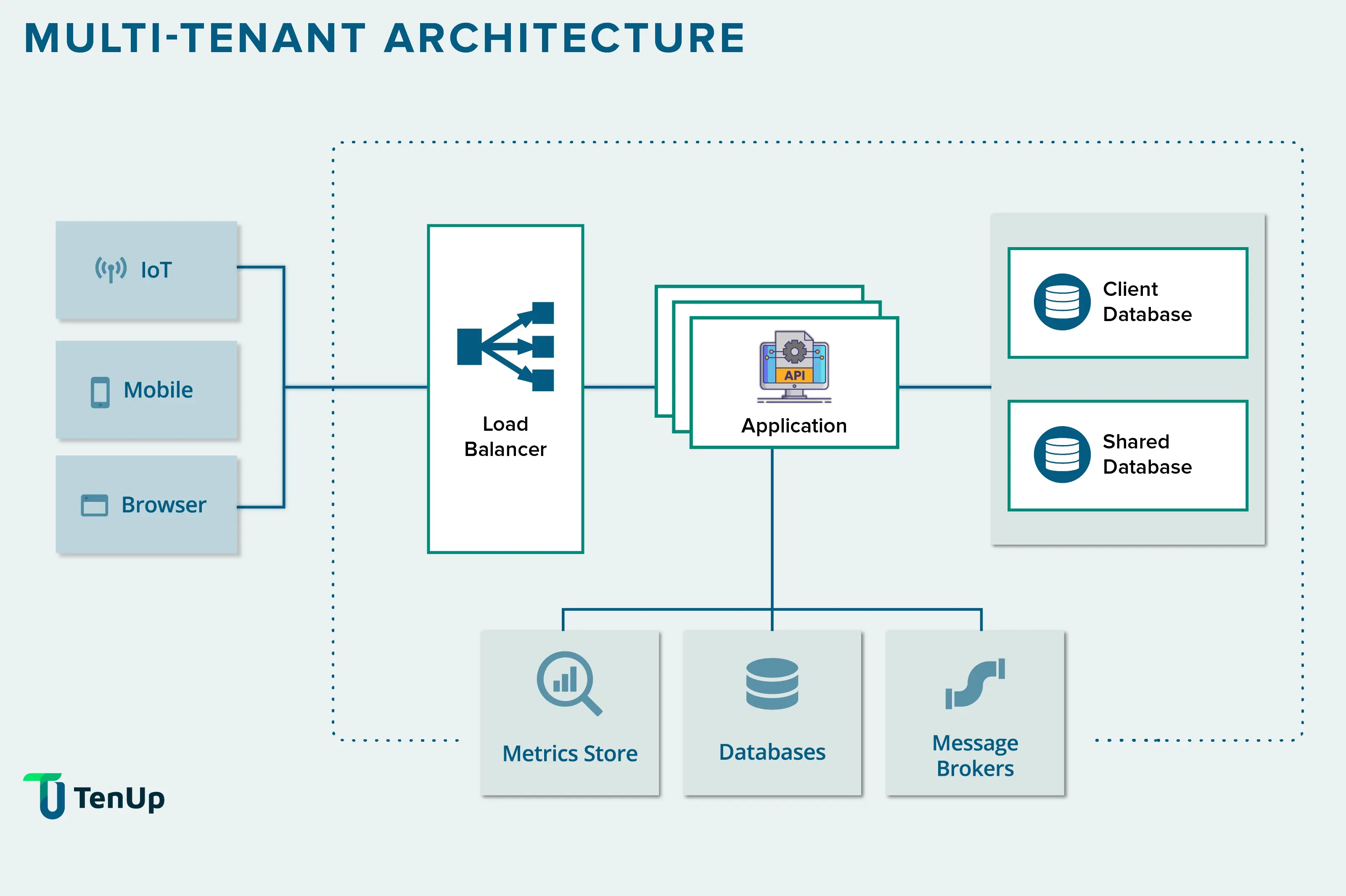
Multi‑tenant architecture is a software architecture paradigm in which a single application instance runs on shared infrastructure and serves multiple customers (tenants). Each tenant shares the same codebase and runtime, but their data and configurations are logically isolated—typically through separate schemas, tenant‑in‑one‑database patterns, or dedicated tenant‑specific databases.
This approach is widely used in SaaS applications, where shared infrastructure improves efficiency, reduces operational cost, and simplifies upgrades, while logical isolation ensures privacy, security, and compliance across tenants.
Multi‑tenant architecture is a foundational element of SaaS application architecture, enabling vendors to deliver scalable, cost‑effective services on public clouds such as Microsoft Azure, Google Cloud, and AWS.
How multi-tenant architecture is used
- Multiple tenants share a single application instance
- The server serves multiple tenants simultaneously
- Logical isolation is maintained between customers
- Shared infrastructure improves efficiency and scalability
Role of multi-tenancy in SaaS
Multitenancy is key to the implementation of software as a service, which is why many SaaS and cloud companies make use of this architecture.
Choosing the Right Application Architecture for Enterprise Modernization
Enterprises on their digital transformation path often wonder about the right architecture choices for their application development. Integrating architecture planning into the Software product development lifecycle enables better scalability, maintainability, and long-term business success.
Modern application architecture for the enterprise requires balancing:
- Scalability
- Security
- Cost efficiency
- Continuous evolution across legacy and cloud-native systems
At TenUp Software, we deliver powerful, fast, and optimum designs for your application architecture and have a wide range of experience working with different design paradigms and approaches.
Interested in finding out more about the most appropriate Digital Transformation solution for your business? Contact us and our expert will reach out.
Are you choosing an architecture that will scale with your enterprise needs?
TenUp helps enterprises define and implement application architectures that balance scalability, security, and long-term evolution. Get started today.
Frequently asked questions
How do enterprises decide when to modernize application architecture instead of optimizing legacy systems?

Enterprises choose modernization when legacy systems begin to slow innovation, limit scalability, increase operational risk, or block cloud and real-time capabilities. While optimization can extend legacy systems temporarily, modernization is needed to support faster releases, better resilience, and long-term business growth.
What are the most common signs that an application architecture is no longer future-ready?
An application architecture is likely not future-ready if it struggles to scale, breaks during releases, slows development due to tightly coupled components, or is expensive to maintain. Difficulty integrating with cloud services, modern APIs, or real-time systems is another strong signal that the architecture is limiting innovation and business growth.
Is microservices architecture always the best choice for enterprise modernization?
No. Microservices offer scalability and faster releases but add operational complexity in areas like monitoring, data consistency, and service communication. Many enterprises achieve better results with a modular monolith, SOA, or hybrid approach, depending on team maturity, system complexity, and business goals.
What role does application architecture play in DevOps and continuous delivery?
Application architecture enables DevOps and continuous delivery by allowing applications to be built, tested, and deployed independently. Architectures such as microservices and cloud-native designs support automation, frequent releases, faster rollbacks, and better resilience, making CI/CD practical, reliable, and scalable.
What is the biggest mistake enterprises make during application architecture modernization?
The biggest mistake is adopting modern architecture trends without aligning them to business goals. Effective modernization focuses on solving real problems: scalability, speed, and reliability, before choosing technologies, teams can sustainably build and operate.
What are the benefits of monolithic architecture?
Monolithic architecture offers simplicity, faster development, and lower initial cost by keeping all components in a single codebase. It enables easy deployment, straightforward testing and debugging, and better performance due to low-latency internal communication, making it ideal for startups, MVPs, and small to mid-scale applications.
How does microservices architecture improve scalability in containerized environments?
Microservices scale independently inside containers, so only high-demand services use additional resources. Orchestrators like Kubernetes automatically scale these services based on traffic, improving performance and cost efficiency.
Which serverless compute service lets you run functions without provisioning or managing services?
AWS Lambda is the primary serverless compute service that lets you run functions without provisioning or managing servers. It automatically handles scaling and infrastructure and charges only for execution time, enabling faster development and lower operational overhead.
Share the Article


