


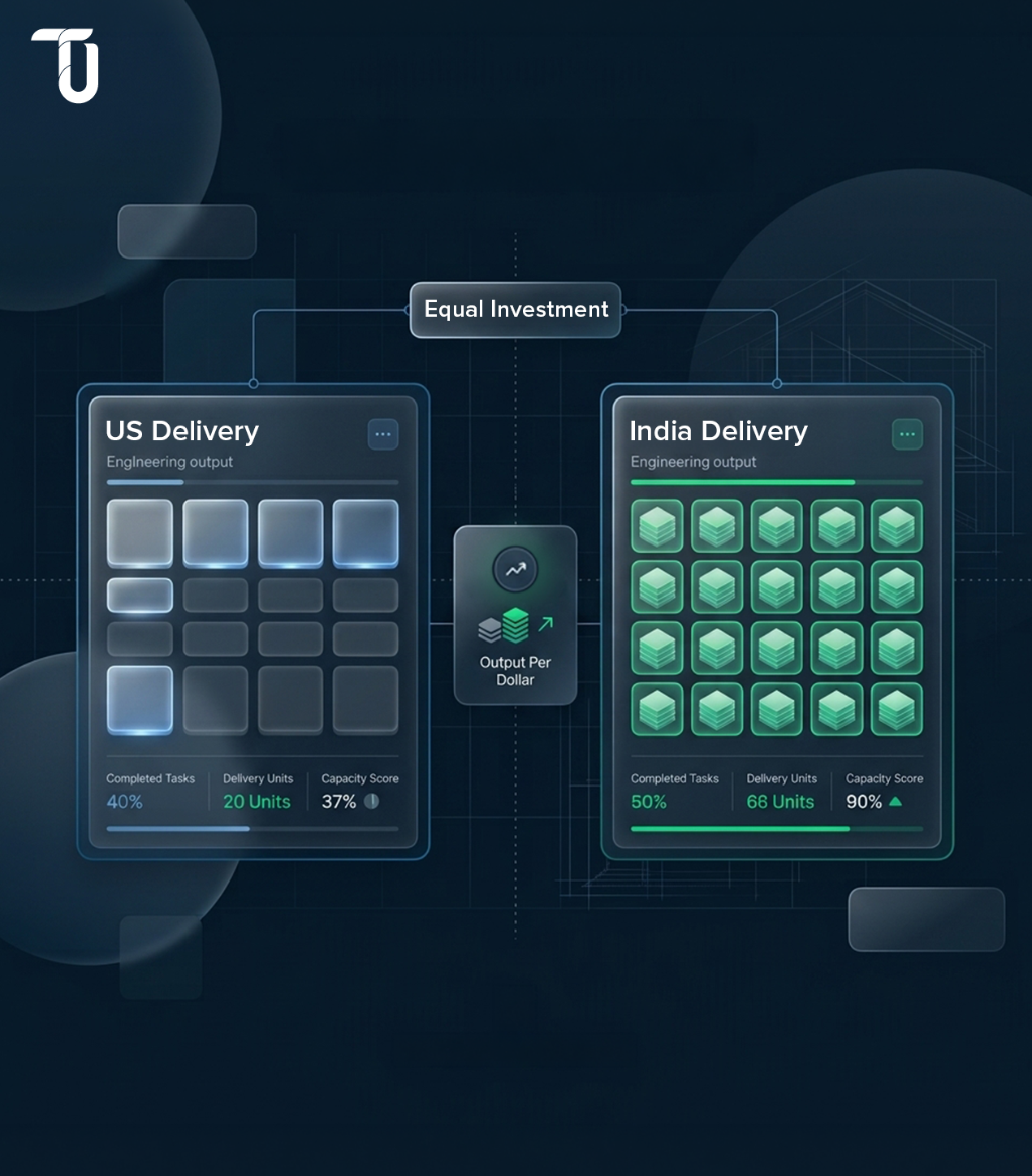
Most AI budgets are built around the wrong number. Leaders scope against the build cost. The number that determines ROI is the 36-month cost of ownership, which routinely runs 2x-3x the initial quote once infrastructure, retraining, compliance, and support are factored in.
AI software development cost in 2026 is a function of model architecture, data readiness, integration depth, infrastructure design, and team location. Most project budgets underestimate at least three of those five. For teams evaluating vendors, this guide on custom AI software development covers the build strategy decisions that precede cost.
Where offshore AI development changes the math is not in hourly rates. It is in flattening the TCO curve, making production-grade AI accessible for startups, mid-sized businesses, and regulated enterprises that cannot absorb US agency rates for full-scope delivery.
This blog covers what drives AI software development cost, what projects cost across types and regions, where offshore delivery changes the equation, and how to build a budget that holds beyond the first sprint.
What Actually Drives AI Software Development Cost in 2026?
AI software development cost is determined by five variables: model architecture choice, data readiness, team location, integration complexity, and infrastructure design. Architecture choice alone creates more cost variance than the other four combined.
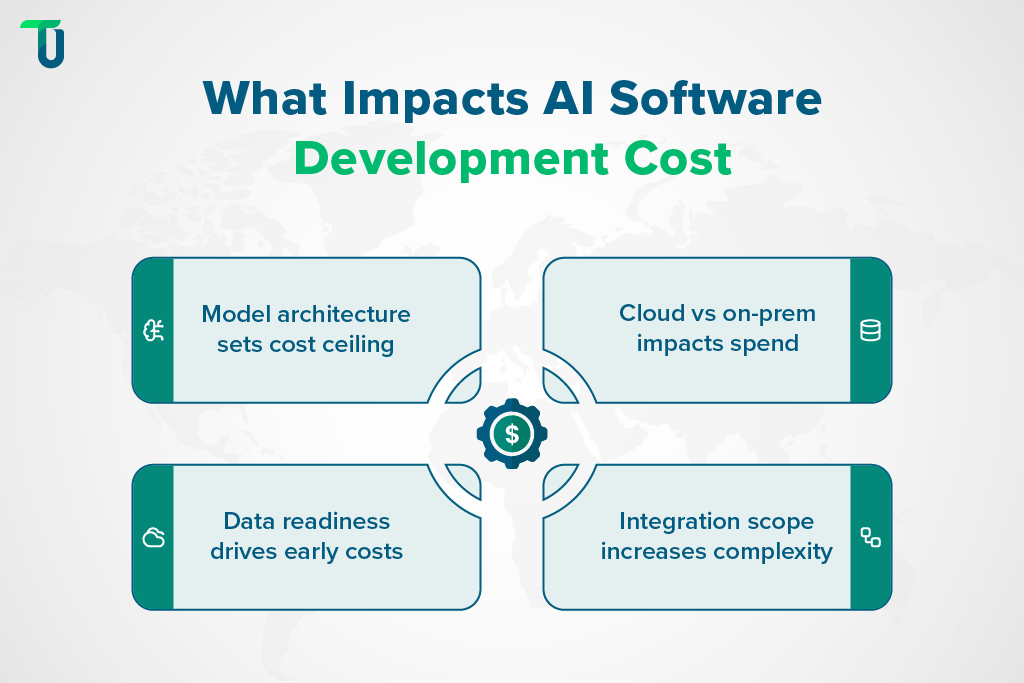
Model Architecture: The Decision That Sets the Cost Ceiling
Three architecture paths exist, each with a distinct cost profile, trade-off, and decision trigger.
1.API-based AI (OpenAI, Anthropic, Gemini)
Build cost: $30K-$80K
Best for: fast-to-market builds, low to mid call volumes
Trade-off: Per-token fees scale with usage. At high volumes or stable feature scope, it becomes the most expensive long-term option.
2.Fine-tuned open-source model (Llama, Mistral)
Build cost: $50K-$200K
Best for: high call volumes, stable feature scope, full model ownership
Trade-off: Higher upfront cost. Eliminates per-token fees. The broader trade-offs between open-source and proprietary LLMs extend beyond cost to latency, compliance, and control.
3.Custom-trained proprietary model
Build cost: +$100K-$1M+ for most enterprise-scale use cases, with very large multi-model or multi-region deployments exceeding this
Best for: specialized accuracy, latency, or compliance requirements that off-the-shelf architectures cannot meet
Trade-off: Highest investment. Justified only when no existing model fits the requirement.
The fine-tuning vs. full training decision directly affects dataset requirements, GPU compute costs, and timeline. TenUp's background removal and replacement project for a US-based automotive photography company illustrates this: choosing to fine-tune a pre-trained OSS Segmentation Model over training from scratch, using 20,000 4K images and five A100 GPUs, compressed both timeline and compute cost while delivering accuracy that exceeded the third-party tool the client had been paying per-image fees to use.
On-Premise vs. Cloud Inference: The Regulated Industry Variable
Cloud inference offers flexibility and lower upfront cost. On-premises becomes cheaper at high inference volumes, and in regulated industries where data residency requirements restrict public cloud processing, it is often a compliance requirement rather than a cost choice.
Data Readiness: The Most Underestimated Pre-Build Cost
The condition of your data determines how much budget is consumed before a single model trains. Structured, labeled, clean data from a single source is the best case. Raw, siloed, or unstructured data, spread across legacy systems, CRMs, and unformatted documents, requires cleaning, labeling, and structuring first.
For many enterprise AI engagements, data preparation can consume 20-40% of early project spend. Teams that do not account for this upfront discover it mid-build, when timelines are locked and the budget is already committed.
Integration Scope: Where Enterprise Projects Diverge From Startups
A standalone AI tool costs a fraction of an AI system that must connect with ERP platforms, CRM databases, legacy infrastructure, and third-party services. Each integration layer adds middleware complexity, API management overhead, security validation, and testing cycles.
TenUp's AI Purchase Order Automation for a US-based manufacturing distributor shows how quickly integration scope compounds. The system deployed a multi-agent agentic AI framework using LangChain Graph, integrating SAP, Zendesk, AWS Bedrock, and internal product databases simultaneously. The result: 98% reduction in PO entry time and 85% shorter billing cycle. None of that was achievable with a standalone tool, and none of the integration complexity was visible in the initial project description.
The cost of an AI project is largely determined at the architecture decision point, before a single sprint begins.
AI Development Cost by Project Type (2026 Benchmarks)
AI development costs in 2026 range from $20,000 for a scoped proof of concept to over $1.5M for enterprise-grade autonomous systems, with the spread driven by model type, data volume, and integration depth. For India-based full-cycle development, covering architecture, data preparation, build, integration, MLOps, and post-launch support, equivalent projects typically cost 30-70% less than US-based engagements, with the exact savings depending on engagement model, scope, and vendor tier.
| Project Type | Complexity | US Cost Range | India Full-Cycle Range | Typical Timeline |
|---|---|---|---|---|
| Proof of Concept | Low | $20K-$60K | $8K-$25K | 4-8 weeks |
| AI Chatbot (Rule-Based) | Low | $25K-$70K | $10K-$30K | 6-10 weeks |
| NLP / Advanced Chatbot | Medium | $50K-$150K | $20K-$65K | 10-16 weeks |
| ML Model (Predictive Analytics) | Medium | $50K-$200K | $20K-$80K | 12-20 weeks |
| Computer Vision System | High | $100K-$500K+ | $40K-$200K | 16-32 weeks |
| AI MVP (Production-Ready) | Medium | $60K-$150K | $25K-$65K | 10-18 weeks |
| Production AI System | High | $150K-$600K | $60K-$250K | 20-40 weeks |
| Custom LLM / Fine-Tuned Model | Very High | $200K-$1M+ | $80K-$400K | 24-52 weeks |
| Agentic AI / Multi-Agent System | Very High | $300K-$1.5M+ | $120K-$600K | 28-56 weeks |
Cost ranges assume full-cycle delivery covering architecture, data preparation, build, integration, MLOps, and post-launch support. Staff-augmentation-only vendors may quote lower numbers but typically exclude these layers, and the gap surfaces as unplanned spend in year two.
India full-cycle delivery compresses these budgets for three reasons:
- Senior AI engineers at often 30-70% lower effective rates than US equivalents, depending on vendor tier and stack
- Production-ready MLOps and compliance capabilities included in core scope, not billed separately
- Established delivery frameworks that reduce build cycle time without reducing quality
AI MVP Cost vs. Production-Grade System: What the Gap Actually Means
The difference between a demo MVP and a production-foundation MVP is what gets cut: MLOps pipelines, model monitoring, retraining infrastructure, and production-grade security. These are not optional extras. They determine whether the system maintains accuracy, handles scale, and avoids regulatory exposure after launch.
Teams that cut these layers to hit a budget target typically spend 2x-3x more rebuilding them six to twelve months later, after the MVP has been adopted and the architecture is harder to change.
Generative AI Application Cost in 2026
The cost of a generative AI application varies significantly by architecture choice:
1. API-wrapped GenAI product (OpenAI / Anthropic endpoints + custom UI): $30K-$80K. Fastest to build, lowest upfront cost. Per-token fees compound at scale.
2. RAG architecture (retrieves from a proprietary knowledge base): $60K-$180K depending on corpus size and integration complexity. Better accuracy on domain-specific queries without full model training.
3. Fine-tuned model on proprietary data: $150K+ scaling with dataset size and compute requirements. Highest upfront cost, lowest marginal cost at volume, full model ownership.
The cheapest option is often the most expensive long-term decision, particularly when the MVP architecture becomes the production architecture.
Need a realistic AI software development cost estimate?
TenUp delivers end-to-end AI development with transparent, data-driven scoping and full lifecycle ownership, for enterprises and startups alike.
Why Full-Cycle AI Development From India Delivers More Value Per Dollar
Most cost comparisons frame this as a US agency vs. Indian developer. The real comparison is US agency vs. India staff-augmentation vs. India full-cycle partner, three engagement models with three different cost and delivery outcomes. The hourly rate gap is real, but the TCO advantage comes from what a full-cycle Indian partner includes in scope that a US firm bills separately and a staff-augmentation vendor does not deliver at all.
What Full-Cycle AI Delivery Actually Includes
Full-cycle AI delivery covers:
- Architecture design
- Data pipeline engineering
- Model development and integration
- Compliance implementation
- MLOps setup
- Post-launch support and maintenance
A staff-augmentation vendor provides engineers who execute tasks your team defines. A full-cycle partner owns the outcome, not just the hours.
This distinction matters most during integration, where early architectural decisions determine long-term maintenance cost, and post-launch, when model drift, compliance updates, and infrastructure scaling require the same engineering judgment that built the system.
The Value-Per-Dollar Argument
At equal budget, a US agency and a full-cycle Indian partner are not delivering the same thing.
What $300K buys
| Item | US AI Agency | India Full-Cycle Partner |
|---|---|---|
| Development | Yes | Yes |
| Architecture consulting | Billed separately | Included |
| MLOps setup | Billed separately | Included |
| Compliance engineering | Billed separately | Included |
| Post-launch support | Billed separately | Included |
The effective cost difference for equivalent scope is 50-70%. Senior AI engineers in the US charge $120-$220/hour; comparable talent in India charges $30-$75/hour. A production-ready ML platform that costs $400K with a US agency can be matched in scope by a full-cycle Indian partner at $140K-$200K, at the same timeline.
For startups and mid-sized businesses, this makes production-grade AI accessible at budgets previously limited to proof-of-concept work.
The 24-Month Cost of Ownership Comparison
Year one is the build. Year two is where the cost model diverges. A US firm that hands off support after delivery bills post-launch work at full consulting rates, $150-$250/hour, for issues that require understanding of the original architecture. A full-cycle Indian partner supports the system with the same team, resolving faster because context is already established.
Over 24 months, the TCO advantage compounds across retraining cycles, compliance updates, feature iterations, dependency updates, and SLA-backed incident response. These represent 40-60% of total 24-month spend for most enterprise AI deployments.
TenUp's Take: The offshore decision should never be framed as trading quality for cost. The right full-cycle partner brings the same architectural rigor, compliance depth, and delivery ownership as a US firm, with economics that free budget for scale, not just build.
The Hidden Costs That Blow AI Budgets in Year Two
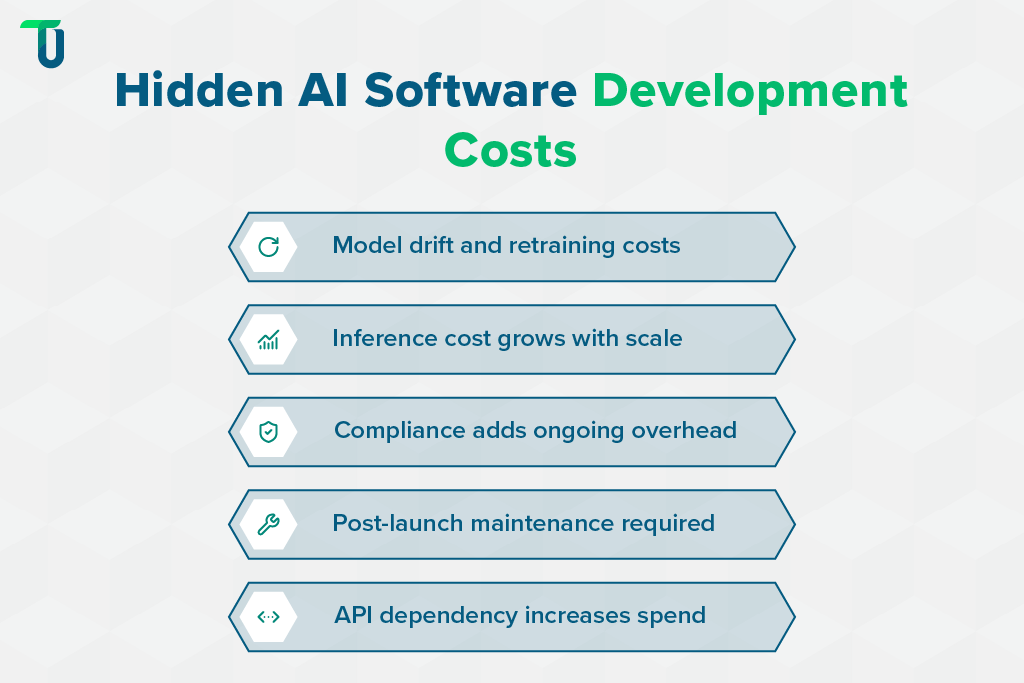
The five most consistently underestimated AI development costs are model retraining, inference compute at scale, compliance engineering, post-launch maintenance and support, and API dependency. None appear in a standard vendor quote.
Model Drift and Retraining Costs
Production AI models degrade. A model trained six months ago may perform materially worse on current inputs, particularly in domains where language, behavior, or market conditions shift. Correcting drift requires monitoring infrastructure, periodic retraining cycles, and MLOps tooling.
Annual retraining and monitoring costs typically run 15-25% of the initial build cost. For a $200K build, that is $30K-$50K per year, a line item that rarely appears in the initial project proposal.
TenUp's AI workflow automation platform for a US-based automotive photography company built exactly this infrastructure: a continuous retraining pipeline integrating CVAT.ai, Vast.ai, Wandb.ai, and AWS SageMaker processing 500-1,000 flagged images daily, reducing AI tool error rates by 15-20%.
Teams building MLOps and ML experiment tracking capabilities from day one spend significantly less on drift correction than teams retrofitting it post-launch.
Inference Compute at Scale
Model training is a one-time cost. Inference scales with usage and often exceeds build cost by year two for high-volume applications. A model processing 100,000 requests per day at $0.002 per call generates $72,000/year in inference costs alone.
For high-volume applications, on-premise inference becomes the cheaper alternative. The upfront hardware cost is higher, but marginal cost per inference approaches zero at scale. In regulated industries with data residency requirements, on-premise inference is often a compliance requirement, not just a cost optimization.
Compliance and Governance Engineering
Compliance is not a one-time review. The major frameworks adding cost in 2026:
- HIPAA: Audit trails, encryption at rest and in transit, access logging
- SOC 2: Annual certification, security controls, availability monitoring
- EU AI Act: Transparency documentation, bias testing, and human oversight for high-risk systems (phased enforcement through 2027)
- US AI governance frameworks: Mandatory documentation and audit requirements for financial services and healthcare
Compliance engineering adds $20K-$80K to initial build cost and $15K-$40K annually for audits and control maintenance.
TenUp's AI Watchlist Screening Software for a US-based fintech company illustrates compliance engineering at scale. The system combined NLP, text mining, fuzzy logic, phonetic matching, and Levenshtein distance-based string similarity to screen 5M+ records daily against OFAC, OSFI, PEP, Interpol, and regional watchlists simultaneously. Outcome: under 1% false positives and 100% watchlist data freshness. That level of regulatory accuracy required compliance to be a core architectural decision, not a post-training layer.
Post-Launch Maintenance and Support
A production AI system requires ongoing engineering after launch: bug fixes, dependency updates, security patches, and SLA-backed incident response. When these responsibilities fall to a different team than the one that built the system, resolution time increases, as the incoming team must reconstruct context before acting.
Ongoing maintenance typically runs 15-20% of initial build cost per year. Organizations working with a full-cycle partner receive post-launch support from the same team, with the same architectural context, meaning faster resolution and no knowledge transfer overhead.
The API Dependency Tax
Building on third-party AI APIs means accepting per-token pricing, vendor-controlled rate limits, model deprecation timelines, and pricing changes outside your control. At scale, this becomes a structural cost risk.
A production application generating 1 million API calls per month at $0.01 per 1,000 tokens costs $120,000/year in API fees alone. The same workload on a fine-tuned open-source model hosted on AWS typically runs $2,000-$4,000/month in GPU compute. When projected monthly API spend exceeds $10K-$20K with stable feature scope, switching to a fine-tuned OSS model pays back in 6-12 months. Teams evaluating open-source LLM hosting options will find the infrastructure requirements more accessible than the migration cost suggests.
AI total cost of ownership over 24 months is routinely 2x-3x the initial build quote. Leaders who do not model the full lifecycle are pricing a demo, not a production system.
AI Project Cost Breakdown: How to Build a Budget That Holds
A defensible AI development budget allocates spend across four phases: data and discovery, build and integration, compliance and testing, and post-launch operations. Skipping or underweighting any phase creates costs that surface later at higher rates.
Phase 1 — Discovery and Data Audit: 8-12% of total budget
Assess data quality, map integration dependencies, define model architecture, and validate technical feasibility before development begins. This is the most skipped phase and the most consequential. Mid-build architecture revisions cost 3-5x more than planning-stage corrections.
Phase 2 — Build and Integration: 40-50% of total budget
Core model development, system integration, UI/UX, and API connections. This is the phase most vendors quote, and the only phase some of them include.
Phase 3 — Compliance and Testing: 10-15% of total budget
Security audits, bias testing, compliance validation, load testing, and pre-launch performance optimization. In regulated industries, this phase requires third-party review.
Phase 4 — Post-Launch Operations (Year 1): 20-30% of total budget
Model monitoring, retraining cycles, bug fixes, dependency updates, infrastructure scaling, and SLA-backed support. Consistently underbudgeted and treated as a post-launch line item rather than a core project cost.
The 30% Rule for AI: What It Is and When It Breaks Down
A common industry heuristic is to allocate 30% of a software development budget to AI integration. For mid-complexity integrations using pre-built APIs or fine-tuned models with clean data, this holds reasonably well.
It breaks down in three scenarios:
1. Custom model development: Model training and MLOps alone can consume 50-60% of total project budget
2. Compliance-heavy industries: Governance engineering adds layers not captured in a percentage-of-software formula
3. Data-scarce environments: Building training datasets from scratch exceeds the model development cost itself
Treat it as a starting point, not a reliable fixed ratio.
Will AI Development Costs Increase or Decrease Beyond 2026?
What is getting cheaper: Hardware competition from NVIDIA's Blackwell architecture, Google TPU v6, and emerging NPUs is driving down GPU compute pricing. Open-source model proliferation, including Llama 4, Mistral, and DeepSeek, is reducing the marginal cost of model capability.
What is getting more expensive: The EU AI Act's enforcement timeline runs through 2027. Emerging US AI governance frameworks are adding mandatory documentation, audit, and oversight requirements for high-risk systems. Annual third-party audits for regulated AI can add $30K-$100K or more to the maintenance budget, depending on scope, jurisdiction, and company size.
The net effect is that overall TCO is stable or slightly rising because compliance overhead is absorbing the infrastructure savings. Locking in architecture decisions and vendor relationships now—before additional regulatory layers add mandatory costs—is a better budget strategy than waiting for compute prices to fall further.
In-House vs. Agency vs. Freelance: The Real Cost Comparison
For context, typical annual or engagement costs fall in the ranges below. Actual figures vary by scope, team composition, and contract structure.
| Option | Annual / Engagement Cost | Best For | Trade-off |
|---|---|---|---|
| In-House Team (5-person) | $800K-$1.2M/year (reflecting senior-heavy AI/ML salaries plus overhead and tooling in the US) | AI as core product, maximum control over roadmap and data assets | Longest ramp-up, highest fixed cost regardless of project cadence |
| Full-Cycle Offshore Agency | $150K-$400K/engagement | End-to-end delivery, startups to enterprise | Shared architectural ownership |
| Freelance | Lowest per-hour rate | Isolated, well-defined tasks | Highest management overhead and IP risk; coordination overhead erodes rate saving fast |
Strategies to Reduce AI Development Cost Without Compromising Quality
Use open-source models where proprietary APIs are not justified. Llama and Mistral deliver competitive performance for most enterprise use cases and eliminate per-token fees at scale.
Build in phases. A production-minded MVP covering core functionality, basic MLOps, and monitoring is a better first investment than a fully featured system built to a spec that will change.
Right-size infrastructure from day one. Over-provisioned GPU compute during development and staging is one of the most common sources of unnecessary spend.
Choose a vendor who includes post-launch maintenance in the engagement scope. The handoff tax, transferring context from a build team to a separate support team, consistently inflates year-two costs.
The engagement model a vendor proposes tells you more about their risk posture than their portfolio does. Fixed-price vendors who do not ask hard questions about data readiness are pricing the quote, not the project.
Build AI That Delivers Beyond the Launch Date
AI software development cost is a budget architecture, and the one that holds is built around all five variables, not just the development sprint.
The organizations extracting real ROI from AI share one pattern: they modeled the 36-month cost of ownership before committing, chose architecture that matched actual volume and compliance requirements, and partnered with a team that owned the full delivery lifecycle.
TenUp delivers end-to-end AI development, including Generative AI, Vision AI, Agentic AI, Machine Learning, and AI integration services, with full-cycle ownership from architecture through post-launch support. ISO 27001 certified and an AWS Partner, TenUp has built AI systems across industries.
TenUp has delivered:
- AI compliance systems for financial services with 90%+ fraud detection accuracy for a US and Canada fintech client
- Enterprise automation platforms integrating multi-agent AI with legacy ERP systems, with 98% reduction in PO processing time for a US manufacturing distributor
If your AI budget is built around the build cost, it is built around the wrong number. Explore TenUp's enterprise AI development services to start with the full picture.
Planning an AI software development project?
TenUp will scope it with full lifecycle cost visibility, from architecture decisions to year-two operations. No surprises.
Frequently asked questions
How much does AI software development cost in 2026?

AI software development cost in 2026 ranges from $20,000 for a scoped proof of concept to $1.5M+ for enterprise-grade autonomous systems. The range is driven by model architecture, data readiness, integration complexity, and infrastructure requirements. India-based full-cycle development typically costs 30-70% less than US-based engagements for equivalent scope, with the exact savings depending on vendor tier, engagement model, and scope.
What is the average AI development cost per hour in the US vs. India?
Senior AI engineers in the US charge $120-$220/hour. Comparable talent in India, including ML engineers, LLM engineers, data scientists, and MLOps engineers, typically charges $25-$80/hour at premium-tier vendors, with specialist roles reaching $75-$100/hour at leading firms. At project level, this translates to a typical 30-70% reduction in total engagement cost when working with a full-cycle Indian partner vs. a US agency, depending on vendor tier, scope, and inclusion of MLOps and compliance.
How much does it cost to build a generative AI application?
An API-based GenAI product with a custom UI costs $30K-$80K. A RAG architecture using a proprietary knowledge base costs $60K-$180K. A fine-tuned model on proprietary data starts at $150K and scales with dataset size and compute. API-based builds carry per-token fees that compound at scale; fine-tuned models carry higher upfront cost and lower marginal cost at volume.
What hidden costs should enterprises budget for in AI development?
Most underestimated costs: model retraining (can run 15-25% of build cost annually for many enterprise AI systems), inference compute at scale (can exceed build cost by year two), compliance and governance engineering (typically $20K-$80K+ depending on industry and regulatory scope), post-launch maintenance and support (often 15-20% of build cost per year), and API dependency, covering pricing changes, rate limits, and model deprecations from third-party providers.
What is the difference in cost between an AI MVP and a production-ready AI system?
An AI MVP scoped to validate a concept costs $25K-$65K (India full-cycle). A production-ready system with MLOps, monitoring, retraining pipelines, security controls, and integration depth costs $60K-$250K+ for equivalent core functionality. Teams that build MVP-only architecture and retrofit production layers later typically spend 2x-3x the original build cost in rework.
When does it make financial sense to outsource AI development to India?
Outsourcing to India makes financial sense when you need full-cycle AI delivery but cannot sustain US agency or in-house costs. It suits production-grade builds with clear ownership. Staff augmentation supports internal teams, but full development engagements better align accountability, integration, and long-term cost control.
What should enterprises look for in an AI software development partner to avoid cost overruns?
Three signals separate partners who price the project from those who price the quote:
- The vendor asks hard questions about data readiness before scoping.
- The engagement model includes post-launch maintenance as defined scope, not an optional add-on.
- The vendor provides a phased cost breakdown covering discovery, build, compliance, and operations, not a single total figure.
Transparent pricing, full-cycle ownership, and ISO 27001-certified security practices are the baseline. TenUp's approach to AI delivery covers all three.
Share the Article


